

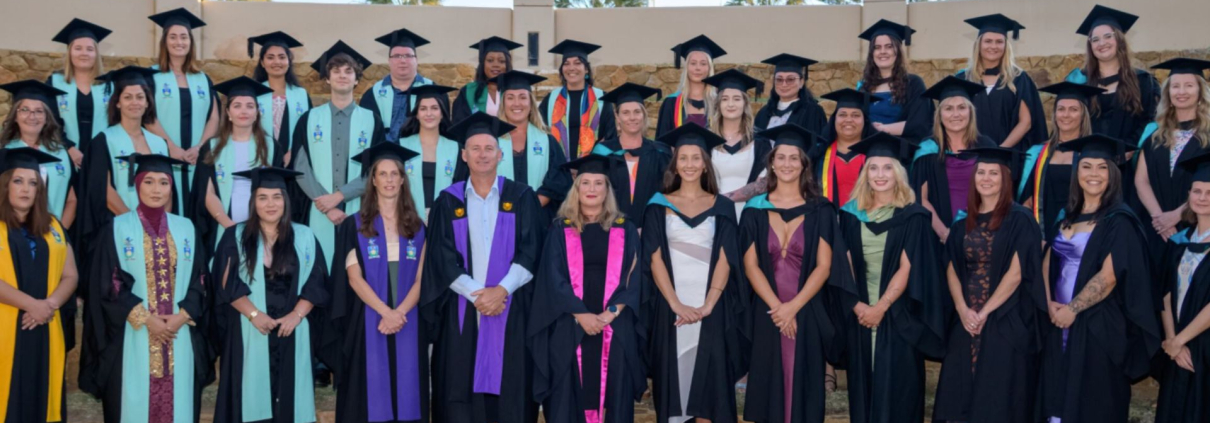

Geraldton Universities Centre (GUC) Annual Hollomby Foundation Scholarship Presentation
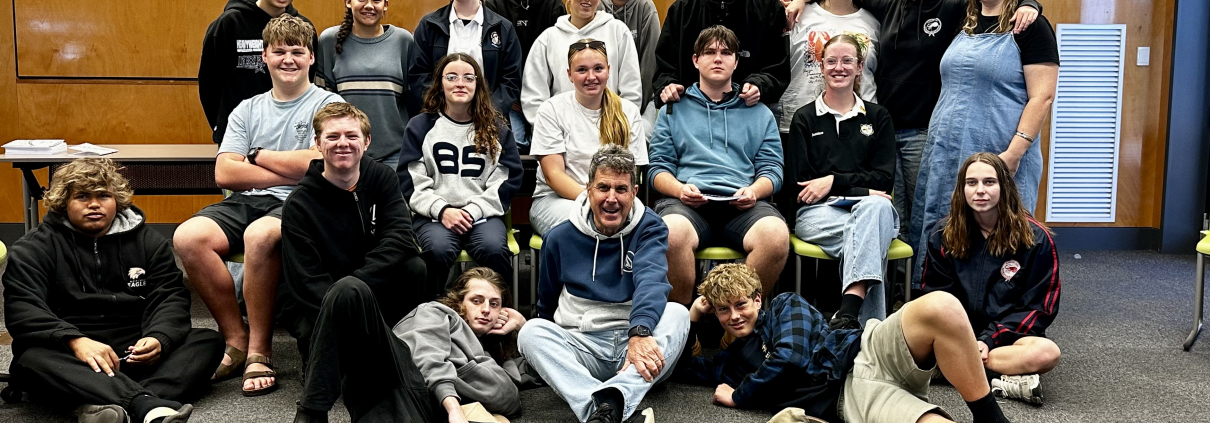
$83,500 in scholarships from local donors was awarded to 27 Geraldton Universities Centre (GUC) students at the annual Hollomby Foundation Scholarship Presentation event on 19 March.
Named in honour of the late charity worker Joe Hollomby, the Hollomby Foundation Scholarship Program provides financial assistance to students studying a degree course through the GUC. Scholarships are provided by a broad range of individuals, businesses and organisations across the Mid West of WA.
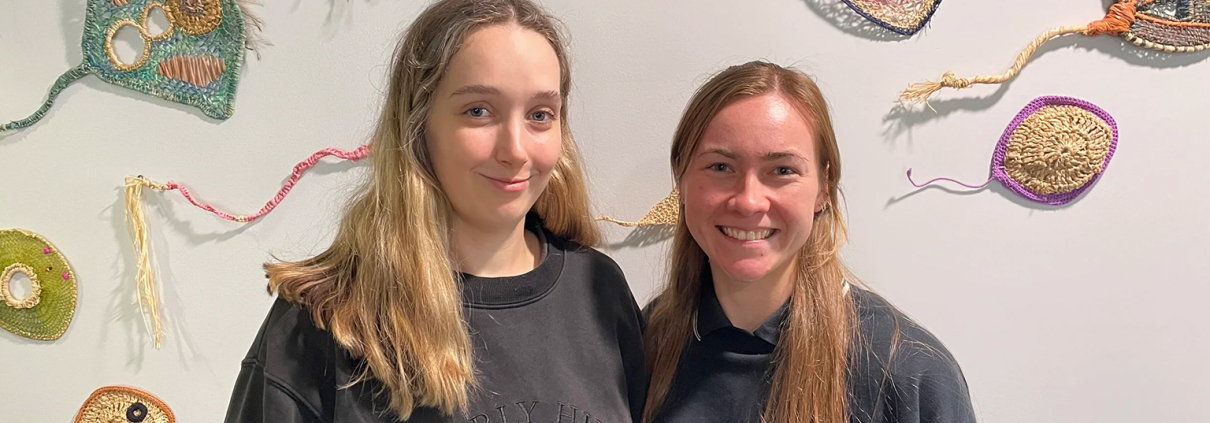
One of the recipients was Peta Humphreys, who was awarded three scholarships. The Mid West Development Commission Scholarship, encouraging high-achieving Year 12 students to enter a course at the GUC, was one of those awarded to Peta for her outstanding Year 12 ATAR of 95.45, which she achieved at Morawa District High School (1.5-hour drive inland of Geraldton) as a Schools of Isolated and Distance Education (SIDE) student. Peta has relocated to Geraldton to study in CQUniversity’s Bachelor of Education, supported by GUC.
The Hollomby Foundation plays a huge role in financially supporting GUC students through their university studies.
GUC Director Natalie Nelmes said, “This year, we continued to hear very compelling stories of the impact that the cost of living is having on students. It makes it very difficult for students to reduce working hours, study full-time and meet family commitments. Support from their community makes all the difference.”

Introducing the new SPERA Executive Members
SPERA is delighted to welcome two new General Executive Members to the 2026 Executive Committee – Donna Ballard and Matthew Thompson.
Donna Ballard
General Executive Member
Donna Ballard is a NSW MidCoast local; her professional journey reflects a strong commitment to community, education and regional opportunity. Actively involved in local volunteer groups, Donna is dedicated to strengthening regional families and contributing to the social and economic development of the MidCoast. As CEO of Taree Universities Campus, she is passionate about removing barriers to higher education and supporting people to study locally.
Matthew Thompson
General Executive Member
Matthew Thompson has worked in outreach and widening participation since 2015, developing and delivering programs across the Macleay Valley that demystify and promote access to further and higher education. He brings a strong connection to Country and extensive experience working collaboratively with Indigenous Australian community stakeholders. Matthew has a diverse background working with industry organisations specialising in event management and holistic individual support, and draws on his lived experience as a neurodivergent learner. He is deeply committed to empowering students to pursue their aspirations and reducing barriers to educational success.

The 2026 Australian Rural Education Awards Opening Soon!
Exciting times are ahead for Australia’s rural education community, with applications for the 2026 Australian Rural Education Awards (AREAs) opening soon.
Since 1994, the AREAs—coordinated by SPERA—have recognised outstanding individuals, institutions, organisations and industry partners who are making a real difference in regional, rural and remote (RRR) education. For more than 30 years, the awards have showcased innovation, partnership and impact, and have become a national platform for sharing excellence in rural education practice.
The AREAs are presented at the National Conference for Regional, Rural and Remote Education (NCRRRE), bringing together educators, researchers, policymakers and community leaders from across Australia. Being recognised as an AREA winner not only celebrates achievement but also amplifies great work on a national stage.
Why apply?
AREA winners receive:
- A professionally produced short film or promotional content showcasing their project
- The opportunity to present to the Regional Education Commissioner and Australian Government representatives
- An invitation to present a SPERA webinar
- A trophy and logo kit for use in communications
Most importantly, winners gain national recognition and the opportunity to inspire others working in RRR education.
Award Categories
The 2026 AREAs will recognise excellence across the following categories:
- First Nations Education
- Regional, Remote, Rural Partnership
- Community Centric
- Research Excellence
- Innovative Project
- Early Education
Whether you are leading a community-driven initiative, delivering innovative programs, strengthening partnerships or conducting impactful research, the AREAs provide a platform to celebrate and share your work.
Want to see the calibre of past winners? Explore previous AREA recipients and their inspiring projects.
To support potential applicants and celebrate excellence, SPERA is also launching the 2026 Webinar Series on 18 February, featuring presentations from 2024 AREA winners. These sessions will offer valuable insights into what award-winning practice looks like and how strong partnerships and innovation are shaping the future of rural education.
Registrations for the webinar series are now open: Sign up here to learn from past winners and be inspired to apply.
Applications for the 2026 Australian Rural Education Awards will open soon. Stay tuned!

Beyond the Pilot
Uni Hub SG, in partnership with BHP and the Roxby Downs Child Care Centre, is pleased to announce the continuation of the Early Childhood Project for a further two years. Building on the strong outcomes achieved during the pilot phase, the extended project reaffirms a shared commitment to strengthening early childhood education and care in regional, rural and remote (RRR) communities.
To date, the project has supported 18 local learners to pursue formal qualifications, including 12 Certificate III in Early Childhood Education and Care, four Diploma of Early Childhood Education and Care, and two Bachelor of Early Childhood Teaching programs. These achievements represent a significant investment in both emerging and existing educators, creating clear and sustainable education-to-employment pathways within the local community.
The continuation of the project has further increased the capacity of the local workforce by upskilling current educators while enabling new entrants to begin or progress their careers without having to leave the region. Importantly, the initiative ensures that high-quality early childhood education remains a priority in RRR communities, where access to training and professional development opportunities can be limited.
The success of the Roxby Downs Early Childhood Project has also created a scalable model, enabling other RRR communities to explore and implement similar initiatives. By addressing barriers to access for further education, including vocational education and training (VET), the project demonstrates how strong partnerships can deliver lasting workforce and community impact well beyond the pilot phase.


Highlights from the 2025 National RUSH Widening Participation Forum
SPERA is proud to acknowledge the leadership of our President & Advocacy Director, Chris Ronan, who recently contributed to the 2025 National RUSH Widening Participation Forum hosted by Country Universities Centre at the Australian National University.
The Forum brought together 151 participants from across Australia, uniting practitioners, researchers, policy leaders, Regional University Study Hub teams, and community partners to share ideas, tools, and inspiration for improving equitable education pathways in regional, rural and remote communities.
Across two energising days, attendees engaged with:
- Keynote speakers and a sector panel exploring the future of widening participation
- 15 EARUCP sub-project presentations, showcasing innovation and evidence-led practice
- Six hands-on workshops, each focused on strengthening place-based solutions
- Discussions on how collaboration can drive stronger outcomes for regional learners
The event highlighted the growing momentum of the RUSH network and the critical role regional study hubs play in improving access to tertiary education. SPERA extends its congratulations to Country Universities Centre and all contributors for their generosity, openness and commitment to collective impact.

Northam Regional Study Hub Officially Opened by Minister Jason Clare
SPERA was pleased to see regional higher education in the spotlight with Minister Jason Clare officially opening the new Regional Study Hub in Northam, Western Australia — the fifth hub established by the Lumen Wheatbelt Regional University Study Hubs.
SPERA Secretary Natalie Nelmes attended the event alongside local council leaders, community members, WA universities, and RUSH teams from Albany and Geraldton.
During the ceremony, Northam Study Hub Coordinator Lisa Astle delivered an inspiring speech about her own journey as a mature-aged university student, sharing how access to local study support transformed her life. She spoke about the potential the hub now offers others in the region seeking to pursue tertiary education without leaving their community.
This opening marks another milestone in expanding regional study access and strengthening pathways for rural learners across Australia. SPERA congratulates the Lumen Wheatbelt RUSH team and all community partners involved.

Wanted: AIJRE editorial team and advisory board members!
The Australian and International Journal of Rural Education (AIJRE) is one of the few publications that focus on rural education research, and it is perhaps the only one with an international focus. The AIJRE is building its international reputation and improving its standing as a quality journal. Over the last few years, citation rates for articles in the journal have been steadily increasing, and in the previous year, the number of submissions received doubled. The quality improvement and increased demand for the journal have meant that the workload for editors and reviewers has increased.
Therefore, the editorial team is working on building and diversifying the editorial team and the editorial advisory board. We are looking for people who can commit to editorial processes, and we are looking for board members who come from increasingly diverse geographic and disciplinary contexts to support the Journal’s review needs. These two roles provide an exciting opportunity for rural professionals, researchers, and experienced practitioners to play a role in the dissemination of articles that reflect high-quality research and good practice in rural education. If you are interested in one of these roles, you can have a look at the current membership and roles for editors here and for the advisory board here. Expressions of interest can be sent to john.guenther@batchelor.edu.au. Include your CV and an outline of why you are interested.

AIJRE Issue: Reimagining mobility in rural education: Challenges, opportunities, and paths forward
This special issue explores the complex intersections of mobility and rurality across diverse global contexts. The contributing articles by up-and-coming rural scholars reveal how mobility encompasses multifaceted social, emotional, and cognitive transitions that shape rural individuals’ lived experiences and imagined futures. AIJRE Vol. 35 No. 3

Building the Early Childhood Workforce in Port Augusta
Building on the success of the Roxby Downs Early Childhood Project in 2024, The Strengthening Futures: Early Childhood Workforce Project, Port Augusta is a collaborative, locally-driven initiative addressing the shortage of qualified early childhood educators and teachers in Port Augusta and the Upper Spencer Gulf region. Led by Uni Hub Spencer Gulf in partnership with Central Queensland University, and funded by the Port Augusta City Council and the Office for Early Childhood Development, the project is a model of community-based workforce development.
By focusing on local talent and fostering clear pathways from school to employment, the project supports regional learners with personalised assistance, mentoring, and access to a dedicated study hub. Wraparound services—including literacy, study skills, and wellbeing support—are tailored to address the unique barriers faced by rural and remote students.
Key outcomes to date include 18 local participants entering early childhood education study and employment, a regional mentoring program, and the creation of sustainable career pathways within the community. Importantly, the initiative delivers broader benefits: children gain improved access to quality early learning, parents are better supported to return to work or study, and local residents access stable, meaningful careers.
This place-based approach prioritises internal capacity-building over external recruitment, reinforcing the social and economic fabric of Port Augusta. Strong partnerships—with the Pt Augusta City Council, local schools, child care centres, and universities—have been central to its success.
More than a workforce solution, Strengthening Futures is a scalable model for community development across regional South Australia, proving that investing in people and place leads to generational impact and stronger, more resilient communities.
Uni Hub Spencer Gulf is incredibly proud to be supporting and leading a number of projects delivering regional workforce solutions. Strengthening Futures is a scalable model for community development across regional South Australia, proving that investing in people and place leads to generational impact and stronger, more resilient communities.

Celebrating Community-Led Change in Regional Higher Education
SPERA is proud to acknowledge the Eastern Australia Regional University Centre Partnership (EARUCP) for receiving national recognition for its bold reimagining of university outreach in regional, rural and remote communities.
Led by the University of Technology Sydney (UTS) and the Country Universities Centre (CUC), the partnership spans 25 universities and 14 Regional University Centres across Queensland, New South Wales, Victoria and the ACT. Unlike traditional outreach models, EARUCP works hand-in-hand with local communities to co-design initiatives that respond directly to each region’s unique needs and educational landscape.
Chris Ronan, SPERA CEO and Country Universities Centre CEO, emphasised the power of this approach:
“When communities define their own needs, build their own programs, and deliver them consistently with local people, then incredible impact can happen. We hope that Regional University Study Hubs across Australia will soon be able to build off this initial project and develop their own widening participation activities from 2026.”
The success of EARUCP demonstrates what’s possible when universities and communities collaborate for long-term, sustainable impact. Since its launch, the initiative has reached thousands of students, parents, teachers, and Indigenous Elders through mentoring programs, immersive career experiences, and culturally embedded micro-credentials.
Funded through the Australian Government’s Regional Partnerships Project Pool Program, the initiative is now informing a national roadmap for place-based equity in higher education – an achievement that aligns closely with SPERA’s mission to advance education opportunities for rural, regional and remote Australians.

Highlights from The Australian Student Equity Symposium
SPERA’s Chris Ronan and Natalie Nelmes attended the Australian Centre for Student Equity and Success, ‘Student Equity in an Era of Change 2025: The Australian Student Equity Symposium’ in September.
The Symposium focused on student equity in this era of change, commencing with the perspectives of higher education students with a diversity of backgrounds. It also offered panels on everything from funding, AI and data to pathways, and, of particular interest to SPERA members, regional students.
Natalie was a panel member on the “What works for regional student outcomes”, highlighting the role the Regional University Study Hubs play in supporting regional students to succeed and provided insights from her own centre in Geraldton.
The importance of place-based support for regional students was highlighted across the panel.
Awards were also presented at the Symposium dinner, with the Collaboration and Stakeholder Engagement award going to the Eastern Australian Regional University Centre Partnership for expanding pathways to higher education for regional students using co-design and community-first approaches.

AIJRE Issue: Improving Rural and Regional Student Experiences
This issue of the Australian and International Journal of Rural Education, explores the challenges and opportunities for researching and reporting student experience in rural and regional education. The articles in this issue illustrate how the voices of students can be and are represented through research. AIJRE Vol. 35 No. 2

2024 NCRRRE Wrap Up
The full program and abstracts from the 2024 National Conference for Regional, Rural and Remote Education is now available.
Many thanks to all our presenters, attendees and sponsors for making this conference such a success.
We look forward to seeing you again in 2026!

SPERA talks Higher Education
SPERA developed a unique submission to the Australian Universities Accord featuring a series of rural case studies.
Through these examples, SPERA hope to highlight the very real challenges that students from RRR areas
face in pursuing higher education and the importance of providing targeted support to help them achieve their goals.
SPERA believe that by sharing these stories we can raise awareness about the unique challenges faced by students in RRR communities and inspire policymakers, universities, and other stakeholders to take action to address these challenges.

Read our submission here.

Australian Rural Education Awards
Australian Rural Education Awards (AREAs) have been awarded annually since 1994 to recognise excellence in rural education in Australia.
Australian Rural Education Awards Categories
Regional, Remote, Rural Partnership Award
Demonstrating a successful partnership for students outcomes in a RRR community of praxis
Community Centric Award
Recognition of a person/project/organisation who have placed a RRR community at its’ centre
First Nations Education Award
Recognising excellence in Aboriginal & Torres Strait Islander RRR education
Research Excellence Award
Recognising significant contribution to the Australian RRR education discourse
Innovative Project Award
Innovative programs and practices in RRR education

2022 Australian Rural Education Awards
Since 1994, Australian Rural Education Awards (AREAs) have been awarded annually to an individual, institution, organisation or industry to recognise excellence in rural education in Australia.
Presented by the Hon. Fiona Nash, Regional Education Commissioner, and SPERA President Chris Ronan, the 2022 AREAs were recently announced at the National Conference for Regional, Rural & Remote Education conference dinner Barossa Valley on the 13th of October 2022.
Congratulations to all of the AREA 2022 awardees!
Regional, Remote, Rural Partnership Award
Demonstrating a successful partnership for students outcomes in a RRR community of praxis
Winner: HarvestEd Student Agricultural Program – QLD Virtual STEM Academy & Asia Education
Winner: Wuyagiba Study Hub – Wuyagiba Bush Hub Aboriginal Corporation
Highly Commended: Learning Skills Advisor Program – CUC Far West
Highly Commended: Learn2Learn
Highly Commended: RESN Help, Live and Wiki
Community Centric Award
Recognition of a person/project/organisation who have placed a RRR community at its’ centre
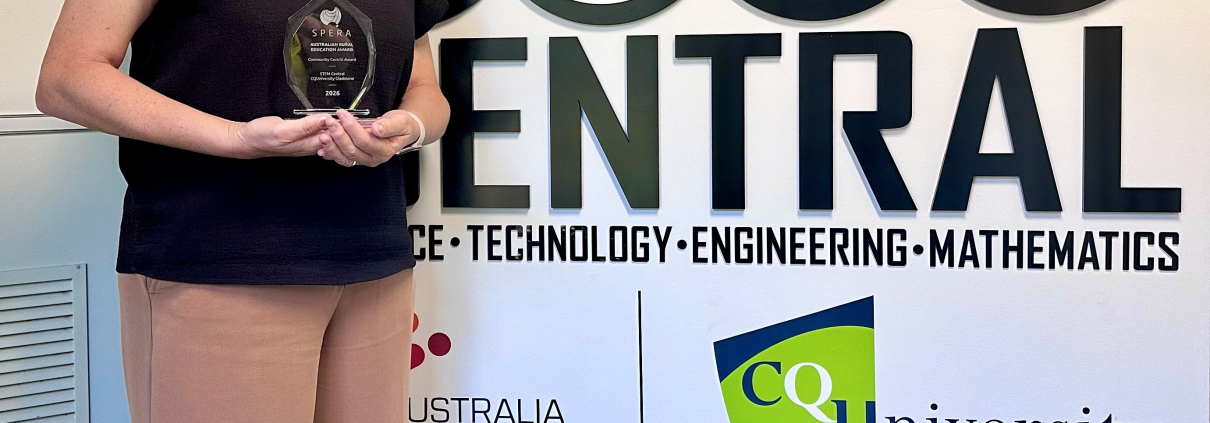
Winner: Geraldton Universities Centre
Highly Commended: Discover Your Future – CUC Far West
Highly Commended: Rural and remote team – QLD Department of Education
First Nations Education Award
Recognising excellence in Aboriginal & Torres Strait Islander RRR education
Winner: Speaking in Colour – Cherie Johnson
Highly Commended: First National Education – CQU
Research Excellence Award
Recognising significant contribution to the Australian RRR education discourse
Winner: Associate Professor Hernan Cuervo
Highly Commended: Dr Mollie Dollinger
Highly Commended: Dr Karen Peel
Innovative Project Award
Innovative programs and practises in RRR education|
Winner: Social Enterprise Schools – Australian Centre for Rural Entrepreneurship (ACRE)
Highly Commended: Learning Skills Advisor Program – CUC Far West
Highly Commended: Learn2Learn
Highly Commended: RESN Help, Live and Wiki
Contact Details
All 2022 AREA finalists have now been published as 2022 AREA Case Studies.

2022 AREA Case Studies
SPERA is thrilled to publish the 2022 AREA Case Studies!
Check out fantastic rural education projects from across the country,
proud finalists of the 2022 Australian Rural Education Awards.

2021 Rural Education Research Portal
Launched at the 2021 National Conference for Regional, Rural & Remote Education (NCRRRE) Webinar, this resource combines 58 rural education abstracts and author contacts, recordings of the Rural Education Webinar and video resources previewed, Heywire vids and 2021 Australian Rural Education Award winning projects.
2021 Rural Education Webinar Monday 24 May 2021 – Recording
Heywire Videos – Inspirational Regional Voices
Brielle: “Going deaf is not a burden”
Zurack: “I knew I needed to step up my game”

International School Leadership Project Documentary
International Rural Schools share their learnings during COVID
NCEHE – National Centre for Equity in Higher Education Research – Regional Rural and Remote
AIJRE – the Australian & International Journal of Rural Education.

AIJRE Journal No 2 2020 – Boarding Schools for rural and remote families: panacea or problem?
The Australian and International Journal of Rural Education has just released Vol 30 No 2 (2020): Boarding Schools for rural and remote families: panacea or problem?
Families living in rural and remote communities often face a difficult choice when their children reach high school age. When there is no local high school, or what is available does not meet their children’s educational needs, one option is to send them to boarding school, which are usually located a long way from home. This is not easy for parents or children. The research presented in this special edition highlights some of the dilemmas and challenges, but also the opportunities that arise as a result of these forced choices.
https://journal.spera.asn.au/index.php/AIJRE