Archive for month: September, 2015

Image of four university students sitting on steps

City & Beyond

Written by Josh, Caitlin and Damien Boccamazzo, and Brent Kealy

City & Beyond is a resource we created for rural students to help with the transition from high school to university. Rural students are at a significant disadvantage to their urban counterparts for primarily two reasons:

  1. Complete lack of information and resources, and
  2. Having no choice but to physically move away from family and friends.

This is problematic because:

  • A disproportionate number of former rural students drop out of university before the end of their first year, and
  • Rural students aren’t properly prepared for graduate recruiting and can’t compete with urban students.

These are problems we’re committed to solving. Ultimately, we want to provide rural students with the guidance to facilitate success so they can reach their potential.

How do we plan to solve this problem?
City & Beyond aims to offer insightful, detailed and practical advice based upon our own personal experiences. We’ve done the research, we know what works and what doesn’t, and we want to equip rural students with the knowledge and skills necessary to succeed.

We aim to comprehensively cover the five pillars of a successful university student:

  • Transitioning to university:
    • This covers the period between finishing high school and starting university.
    • This transition is often a period of rapid change and some guidance on a few key decisions will put students on the right track.
    • We will also include general advice such as: gap year advice, living away from home, selecting and starting university, cooking and diet, keeping fit, etc.
    • Arguably there is a greater emphasis on this period for rural students because they have to face choices and make a series of decisions that urban students do not.
  • Personal finance:
    • Students typically struggle with handling their finances, but with a little education and implementation, they can be a lot better off.
    • Rural students often have to spend more than their urban counterparts which puts an even greater emphasis earning and spending money properly.
  • Time management and organisation:
    • A student’s schedule is typically flexible and revolves around the university semester.
    • Often students have several competing commitments.
    • This creates unique circumstances and a workload that can be managed effectively if students know what they’re doing.
  • Study techniques:
    • While everyone has their own style, there are a few key principles to follow and proper advice can greatly accelerate learning.
    • The learning curve from a high school work load to a university one is often steep and can be unforgiving with fast turnaround in semesters.
    • Rural students typically have less guidance in developing good study habits.
  • Career preparation:
    • This is one area where rural students are often grossly unprepared due to lack of resources and information.
    • Getting in the right mindset and being equipped with the right tools can put students ahead of the pack. Especially given the tough graduate employment market.

Students right now will have immediate access to our advice through a free blog and subscription service.

In the future, we plan to develop:

  • Advanced learning through online video courses and interactive workshops;
  • Mentorship through one-on-one programs and 24/7 on-call service; and
  • Practical tools through templates, information packs and how-to guides.

Ultimately, we want to develop a community of people that will act as a comprehensive resource to bridge the information gap and eliminate the disadvantage suffered by rural students.

How can we make this work?
We’re hoping to reach as many rural students as possible by getting them to sign up to our subscription service accessible at www.cityandbeyond.com.au.

This allows us to:

  • Grow a network of likeminded people committed to helping each other out; and
  • Increase the level of feedback we receive. This ensures we are providing exactly the kind of information rural students need to succeed.

Our current service offering
A more concrete description of what we’re offering at this stage:

  • A growing database of information with five distinct categories – free and available to everyone
  • Subscription service where we deliver structured programs – free and available to everyone who signs up, and
  • 24/7 access to an online mentor – free and available to students who sign up.

This is what we plan to propose to schools in the beginning. As mentioned above, we hope to expand into video courses, full scale mentor programs, workshops, etc., and ultimately create a network of rural students acting as a comprehensive resource.

Who is behind City & Beyond?

Josh Boccamazzo
Graduated Albany Senior High School in 2008; final year law/commerce student at The University of Western Australia; starting graduate employment with Deloitte in 2016; two years of teaching at the UWA Business School; extensive internship experience; committee experience at UWA Business School.

Damien Boccamazzo
Graduated Albany Senior High School in 2011; final year commerce/mathematics student at The University of Western Australia; graduate employment with Ernst & Young starting in 2016; 12 months of experience in college and private tutoring; experience on advisory boards at the UWA Business School.

Caitlin Boccamazzo
Graduated Albany Senior High School in 2011; final year commerce/economics student at The University of Western Australia; graduate employment with Ernst & Young starting in 2016; 24 months of experience in college and private tutoring.

Brent Kealy
Graduated Geraldton Senior High School in 2008; final year law/commerce student at The University of Western Australia; graduate employment with PwC/Strategy starting in 2016; extensive leadership and committee experience at St Thomas More College and UWA Business School; over 18 months of professional work experience.

Image of Parliament House in Canberra Australian Capital Territory

Advance Australia Fair

Written by Nathan Williams

In 2011, I was offered a sponsored place to the Annual SPERA Conference in Adelaide. Now I’m back! I’d like to open the doors of my home to you and why the conference is so important to me.

At the time, I was the first person in our family to attend university. As a young undergraduate, I commuted 600km return each week for two days of on-campus study, because the major I wanted to select was not available in my town. This was in addition to working for the Australian Government Department of Education, Employment & Workplace Relations (DEEWR), and enjoying spending Thursday, Friday & Saturday nights working at a Sizzler restaurant. In-between shifts and late nights waiting for friends to finish often consisted of a university reading or also adding a Certificate IV course into the mix – as you do.

The SPERA Annual Conference challenged my perceptions of ‘bush communities.’ I was astonished and impressed with the impeccable manners, high intellect and beautiful nature of a visiting delegation of students from a remote South Australian community. Teachers who presented were highly innovative, very creative under difficult circumstances, and offered authentic real-world learning for their students – in one case, turning a bankrupt school (and surrounding community) around to profitability in less than a year. The Government and researchers provided long-term statistics and data about why particular Australian-level decisions needed to be made soon to address crisis. A sponsorship reshaped my entire approach to valuing rural and remote Australia, new ways of teaching, and to demand political will for much needed change. The ability to learn, understand structural issues, develop professional networks, and undertake academic growth was priceless.

  • 60% of Australia’s working population are baby-boomers who will retire by 2020. Middle management positions will be in high demand.
  • CSIRO predicts a 70% reduction in annual rainfall across Eastern Australia. This will significantly affect small communities.
  • The New World Order is being challenged and our next generation must have teachers capable of nurturing strong critical analysis skills.
  • Irrelevant of geographic location, parents pay the same amount for their child’s education.

Where am I now? In only four years, I’ve enjoyed a time as the Queensland Young Volunteer of the Year, Advisor to the Prime Minister of the Solomon Islands, attended G20, and have completed my Master’s Degree.

Has the SPERA Annual Conference made a practical difference? Yes. I had the opportunity to petition then Prime Minister, Julia Gillard, and the tertiary sector to consider growing the number of satellite hubs for rural communities and to consider the whole-of-life. We now see satellite university hubs in many parts of Australia, access to the NBN, and universities allowing coursework to begin while students are still in the middle of high school. Imagine a remote community where young people kick off the red dust from their boots and enjoy the same social subculture that students in the city do, by attending a satellite campus near their town, whacking out that law or medicine textbook, eventually setting up businesses in that remote community offering services via video-link to the rest of Australia, and still being able to wake up at 5am to sheer the sheep!

In 2016, only five years later, I will embark on a PhD to design Australia’s first school-based de-radicalisation program. I want my legacy to be that I countered the controversial issue of violent ideology at the school-level.

The Walt Disney of Outback Australia is out there somewhere. They are a student – like me – who needs sponsorship to have their eyes opened to network, to learn, to grow and to return to make a difference in children’s lives.

“With courage let us all combine, to Advance Australia Fair.”

Image of University of Notre Dame students building a playground in red dirt

Notre Dame Pre-service Teachers contribute to the lives of the children in the Tjuntjuntjara Remote Community

Written by Glenda Cain, The University of Notre Dame Australia

The Principal of the Tjuntjuntjara Remote Community School, Daniel Havelberg, has great praise for the ten The University of Notre Dame Australia pre-service teachers and staff who recently spent a week in the school and contributed significantly to the lives of the children.

Tjuntjuntjara is located in the Great Victorian Desert, 1400 kms from Perth. A unique partnership between the School of Education and the Tjuntjuntjara community has grown over the past three years and has provided an invaluable service-learning immersion. As stated by the Principal:

“The opportunity for pre-service teachers to experience and have exposure to the rewards and challenges of teaching in a remote context is extremely valuable. The pre-service teachers are able to spend time in the classrooms with students, talk to teachers, explore and learn about the community, while being supported by the teaching staff and Principal here at Tjuntjuntjara School and the staff from Notre Dame.”

The process of the visit from Notre Dame is well explained by the phrase here in Pitjantjatjara, Ngapartji Npapartji, meaning “I give you something, you give me something.” This process allows the school and community to gain by receiving the service of the pre-service students.

This year, in just four days, the students installed a new playground including soft fall sand, they painted classroom doors, cleaned out the sports and garden sheds, assisted with I.T. issues, repacked the cooking store room, sorted books in the library, fixed leaking taps, and more. This service to the school is invaluable; approximately six months of weekend jobs all done in just a few days. The visiting students gain a valuable insight into understanding and being aware of the cultural, physical, professional and personal rewards and challenges that come with remote teaching. The students spent time in classrooms, played with children, went on bush trips, ate Maku (witchetty grubs), slept under the stars in swags, spent time in the women’s centre and the community as a whole.

The Notre Dame pre-service teachers financed their own participation in this service-learning immersion that included a train trip to Kalgoorlie and then a 4WD adventure of 600kms to reach the very remote Tjuntjuntjara community. However, this expense was worthwhile, and the impact of the service-learning experience is captured in the words of some of the UNDA pre-service teachers:

“The trip to Tjuntjunjara far exceeded any expectations I had. It gave me an insight into how Indigenous Australians live, and what it is like to teach in a remote community. It opened my eyes to the difficulties that remote communities face, and gave me a greater appreciation of Aboriginal culture. The trip was unforgettable, and something I would love to experience again.”


“I volunteered to go to Tjuntjuntjara as I was hoping to find something new, to be challenged. Oh boy, did that happen! This trip challenged me mentally and physically, and it challenged almost all my preconceived ideas about the Aboriginal people and how to teach them in a Western classroom. I was completely ignorant of the differences between our cultures and this trip feels like an important first step in allowing me to become a more informed person and hopefully, a better teacher.”

It is experiences like these that will be shared at the School of Education Service-learning Conference to be held at the university, November 27th and 28th, 2015. More information about this inaugural event can be found on the Notre Dame website.

Image of a skull roses and candle depicting Love Never Dies play

German debut for CQUni Music Theatre graduate

Obtained from CQUniversity Media newsletter and ABC Radio interview

CQUniversity Music Theatre graduate Paul Tabone will soon make his German debut in a return season of Andrew Lloyd Webber’s Phantom of the Opera sequel – Love Never Dies – in Hamburg’s Operettenhaus.

The lyric tenor, who attended CQUni’s Central Queensland Conservatorium of Music in Mackay, has been constantly employed in opera and musical theatre productions since graduating.

Still just 27 years old, Paul has performed at the Verona home of Luciano Pavarotti. For a ‘sold out’ Arena performance, he has shared the stage with operatic icons including Andrea Bocelli and Placido Domingo.

He has made his debut at the National Opera of Bucharest (Romania), Teatro Carlo Felice (Italy), and Teatro Del Giglio (Italy), and performed on Broadway (New York).

Paul grew up on a sugarcane farm, in the small town of Ingham, in Far North Queensland. He graduated from CQUniversity with a Bachelor of Music Theatre in 2009.

Since turning professional, he has performed with Opera Queensland and The Ten Tenors Tenorissimo and has worked with a variety of nationally recognised artists including Rhonda Burchmore, David Campbell, Kate Ceberano, Mercury Four and Guy Sebastian.

When Love Never Dies wrapped its Australian season, Paul decided to move to Europe to pursue his career and further study as a lyric tenor, in where else but Italy.

Inspired by (possibly the greatest tenor of the last century) Luciano Pavarotti, Paul headed overseas to commence study. He has studied with Internationally-renowned baritone Renato Bruscon and has studied in London, Wiesbaden, Milan and Florence.

Early in 2013, Paul auditioned for the Luciano Pavarotti Foundation in Modena Italy, a very convenient 15 minutes away from his current base in Reggio Emilia. The Foundation is directed by Signora. Nicoletta Mantovani (Maestro, Pavarotti’s wife and a prominent producer in Italy).

Signora Mantovani was won over by Paul’s talent and has provided him with invaluable support.

Paul was fortunate enough to be chosen by Signora. Mantovani as one of four tenors to sing at the world renowned Arena in Verona, where he performed alongside some of the most recognised opera singers in the world today, such as Placido Domingo, Andrea Bocelli and Ambrogio Maestri, to a crowd of around 20,000 people. This concert was broadcast with RAI 1 internationally to an audience of over 9 million people. Since then, Paul has traveled internationally and was fortunate enough to perform on Broadway at the New York City Centre in a tribute concert for Luciano Pavarotti, organised by the Foundation.

Paul has performed the role of Duca Di Mantova in Verdi’s Rigoletto in a brand new production for the Opera National in Bucharest, which premiered in August 2014 and was directed by Australian Stephen Barlow.

Paul also has performed the roles of Pinkerton (Madama Butterfly) for the Teatro Del Giglio (Lucca, Italy) and has performed Tony (West Side Story) at the Teatro Carlo Felice in Genova, Italy.

Since then, Paul has travelled internationally and was fortunate enough to perform on Broadway (New York) at the New York City Centre in a tribute concert for Luciano Pavarotti, organised by the Foundation. Paul performed the supporting principal role of Squelch in Love Never Dies in 2011 in Australia.

After successful Sydney and Melbourne seasons, the $9.8 million production was filmed by Universal Pictures International and is currently screening in cinemas and available on DVD & Blu-Ray in over 75 countries.

“I am so privileged to have been asked to again take part in this wonderful production. Australia has produced some of the best shows in the world, and this $9.8 million musical is no exception. Only this time, it will be sung in German in the wonderful Operettenhaus in Hamburg, Germany, with an exquisite international cast. It will be directed again by Australian Simon Phillips” says Paul.

“I have been living and performing in Italy for the last four years, and have been fortunate enough to work all over the world. However, this will be the first time I will perform in Germany. I am so delighted about this because I have had the opportunity to learn about my Italian heritage (as my mother’s parents are both Italian), but now, I will be able to learn about my German heritage, as my great-grandfather was German.”

Liebe Stribt Nie – Phantom II – will open on the October 15, 2015, at the Operettenhaus, Hamburg. For details, visit the Love Never Dies website.

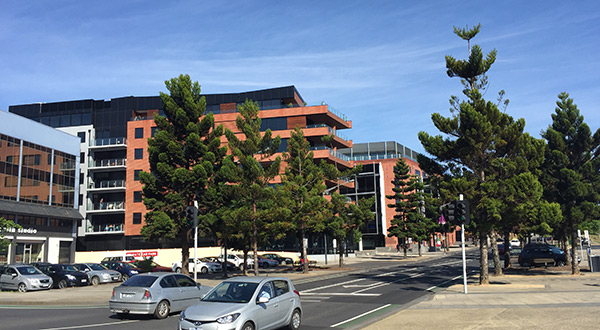
Geelong waterfront view from Deakin University

Deakin University Geelong Waterfront Campus – Travel, Accommodation and Dining

Travelling to Geelong

Geelong is a city located on Corio Bay and the Barwon River, in the state of Victoria in Australia. It is located approximately 75 kilometres south-west of the state capital, Melbourne. Geelong has all of the benefits of a sizeable city, but with the relaxed atmospher of coastal country. Geelong boasts a glorious waterfront precinct, sophisticated dining options and all kinds of entertainment on tap.

Getting there

By Air

Visitors can take flights to Melbourne’s Tullamarine Airport and drive, or take a shuttle bus or train to the Waterfront Campus.

Domestic travellers (or those connecting from Tullamarine Airport) can fly JetStar to Avalon Airport and then drive, or take a shuttle bus to the Waterfront Campus.

Driving

The Waterfront Campus is located approximately one hour’s drive from Melbourne (Tullamarine Airport). All of the major rental car companies have information desks onsite at the airport. The following Google Map shows the route from Tullamarine Airport to the Waterfront Campus.

Avalon Airport is approximately 20 kilometres away from Geelong’s central business district. Some of the major rental car companies have information desks onsite at this airport. The following Google Map shows the route from Avalon Airport to the Waterfront Campus.

Airport Shuttle Bus

From Tullamarine Airport you can use the Gull Airport Service to travel direct to Geelong. Contact, booking, price, and timetable information can be found on the Gull Airport Service website. The pick-up and drop-off point for this service closest to the Waterfront Campus is the Geelong Railway Station. From there you can take a taxi to your hotel.

From Avalon Airport you can use the Avalon Airport Shuttle to travel direct to Geelong. Contact, booking and price information can be found on the Avalon Airport Shuttle website. Please contact this company directly for information on pick up and drop off options in Geelong.

Train

The Geelong Taxi Network website has information on estimating taxi fares, booking online, etc. The contact number for booking a taxi in Geelong is 131 008.

Getting to Deakin University’s Geelong Waterfront Campus

The Geelong Waterfront Campus is located in the CBD of Geelong. SPERA would like to acknowledge that the present site of the Geelong Waterfront Campus is located on the land of the Wathaurong people. They are connected to these lands, have walked these lands, and continue to care for them and nurture them for future generations.

There are many available transport options to this campus.

By Regional Train

The Geelong Train Station is located a short 400 metres away from the Waterfront Campus. V/Line trains operate throughout the day on the Geelong line to Melbourne. The Public Transport Victoria (PTV) website features a helpful journey planner and “University travel” guides located under the “Getting around” tab.

Public bus and coach services

The centrally located Geelong Waterfront Campus is well serviced by suburban bus lines which operate across Geelong and outer regions. The main bus interchange is located in Moorabool Street, 700 metres away from campus. However, there are a number of bus stops close by, depending on your route. The Public Transport Victoria (PTV) website features a helpful journey planner and “University travel” guides located under the “Getting around” tab.

Car

There are limited paid on-street car parking spaces as well as commercial car parks located close to the campus, such as Westfield Shopping Centre on Brougham Street and Civic Centre Car Park on Gheringhap Street.

Geelong Accommodation

The list below provides links to accommodation that can be found in Geelong and located close to Deakin University’s Geelong Waterfront Campus. Please contact the accommodation providers directly for rates, availability and reservations. No recommendations are implied nor responsibility accepted for the standard of accommodation listed.

Novotel Geelong (Located 550 metres away)

Novotel Geelong is the region’s premier hotel and is conveniently located on the waterfront in central Geelong. The hotel is only a short walk to Deakin University and offers views of the bay and a vibrant waterfront location. Free wifi is available throughout the lobby and function floors. The hotel also offers a restaurant, bar, lounge, steam room, fitness centre, and indoor heated salt-water pool. For bookings, please contact the Reservations Team on (61 3) 5223 1377 (extension 1) or visit the Novotel Geelong website.

Mercure Hotels Geelong (Located 900 metres away)

Mercure Hotels Geelong is located in the heart of Geelong, close to shopping and business centres, the Eastern Beach waterfront, restaurants and major attractions. The hotel offers a wide range of business and leisure facilities and services. For more information including rates and bookings, please visit the Mercure Hotels Geelong website.

Quest Serviced Apartments Geelong (Located 950 metres away)

Quest Services Apartments Geelong offers quality 4 star serviced apartment accommodation. Ideal for those with extended stays or wishing to have self-contained accommodation, apartments are spacious and come in studio, 1 and 2 bedroom options. The 1 and 2 bedroom apartments contain a separate lounge area, fully equipped kitche, laundry facilities and balcony. For more information including rates and bookings, please visit the Quest Serviced Apartments Geelong website.


Image of the Queensland State P-10/12 Administrators' Association logo

Queensland State P-10/12 School Administrators’ Association – a brief overview

Written by Geoff Latta, State President, Queensland State P-10/P-12 School Administrators’ Association

The 81 current P-10/12 schools are scattered across our great State and are a very important part of its education history. Our schools are some of the largest and smallest in the State. In 1957, the number of secondary departments, forerunners to what we are now referring to as P-10/12 schools, had increased to 34. This was only three fewer than the number of state high schools at the time.

Currently our schools are made up of three P-9, 34 P-10 and 44 P-12 schools. Our association is very proud to represent all P-10/12 administrators in many forums and to keep promoting the uniqueness of our schools. Our councillors are dotted throughout Queensland; their role is to network with the P-10/12 schools within a given geographical area.

There are particular challenges associated with being a P-10/12 school. These challenges can equally be the strengths of the school. As an example, understanding and creating learning environments in which students can thrive as a 5 and a 17 year old is complex. While mapping out the learning journey from start to finish of primary and secondary schooling provides, I believe, a better understanding of the whole child and their needs.

The Queensland State P-10/12 School Administrators’ Association has a website, eight association newsletters per year and utilises emails to keep our members connected. Principals new to P-10/12 school can access our Principal Survival Kit which has been built up over years by experienced principals in our association.

P-10/12 schools also have the ability to be affiliated with our association. All individual membership and school affiliation fees are used to deliver services to represent and raise the profile of all P-10/12 schools and personnel across all levels of DET. Our association belongs to the members and we genuinely seek their involvement in all aspects of our operations at whatever level they would like to be involved.

Our association represents exceptional value for members and has experienced a surge in interest this year with memberships up by over 25%. I believe there a number of factors involved in this including; the hard work over many years coming to realisation, our Education Minister announcing funding for each Principal Associations’ president (We currently have 0.5 release time for the President’s position), new principals being appointed to some of our schools and the increased level of genuine consultation between the associations and Central Office at all levels.

If you are an administrator in a Queensland P-10/12 school, I hope you seriously consider joining our association and strengthening our ability to represent all P-10/12 schools.

Image of SPERA President Mr Brian O'Neill

Update from the President – Aug/Sep 2015

Thank you for the positive comments regarding the July 2015 edition of the newsletter. Thank you to those of you who have contributed to this edition and to those of you who have indicated that you will be contributing articles in the future.

My vision for SPERA is to reach out and to form partnerships with other organisations that, like us, want to provide educational opportunities, innovative projects and experiences for children in rural, remote and regional parts of Australia. After all, our mission is to “link people with a diverse range of interests in education and training to promote the development of rural Australia.”

I see our role as going beyond preparing teachers to teach in rural areas and in providing quality education services in these rural contexts. We work to provide quality education, innovative practices, conduct research, prepare rural, regional and remote students for a diverse range of careers, including tertiary training and better preparing professional people in a range of occupations for employment in rural, regional and remote communities.

It is for this reason that I am proud to announce that one of our keynote speakers for this year’s SPERA National Conference is Professor Sabina Knight, the National Chair of the Australian Rural Health Education Network and the Director of the Mount Isa Centre for Rural and Remote Health.

We also have parallel sessions regarding “Strengthening partnerships in mental health promotion in rural communities,” presented by a team from CQUniversity Australia, Curtin University, Queensland Department of Education and Training and Queensland Mental Health; and “Living and working in rural communities: Preparation across the professions,” presented by teams from Griffith University and Charles Darwin University.

Within our SPERA membership, we now have an engineering student and a drama student. Both attended rural schools and are now attending regional universities.

I have invited kindred organisations to contribute articles to our newsletter so that we can develop an appreciation of their goals and activities.

The activities of the National Centre for Student Equity in Higher Education (NCSEHE), which is headed by our own Professor Sue Trinidad, are very much aligned with our own and I would like to see us developing a partnership in this.

These kindred organisations are very supportive of SPERA and our activities, including sponsoring presenters and pre-service teachers to attend our conference.

In this newsletter, we introduce the Queensland State P- 10/P-12 School Administrators’ Association. The majority of this association’s schools are situated in rural, regional and remote locations.

Thanks to the NCSEHE, we will be featuring Josh Arnold and Small Town Culture at this year’s conference. As a reviewer, I recently had the pleasure of reviewing a rural P-9 school, Yarraman State School, in the Darling Downs region. Josh Arnold has worked with this school in developing a school song, which was played at the assembly and the students sung with pride. Josh is an impressive man and is doing fantastic work with rural communities and in particular with the children. I also saw Josh in action at the ICPA (Qld) State Conference last year.

Our 2015 Conference Director, Jodie Kline, has provided an update on our conference and I would like to draw your attention to the fact that the closing date for the early bird registrations has been extended to Friday 25 September 2015. I remind you that this date is for the cheaper rate only and that registrations will still be open after that date.

As in previous years, our conference is being sponsored by SPERA member and rural school principal, Peter Shearer. Peter owns a vineyard and is a viticulturist. His label, Wykari of Clare, includes award-winning wines and will be available for order at a discounted rate at our conference.

We have commenced advertising for pre-service teachers to apply for scholarships to attend our National Conference. This will provide them with the opportunity to network, learn about the innovative practices that occur in our rural and regional communities and educational institutions. I would appreciate it if you could bring this opportunity to any pre-service teachers with whom you come into contact.

When I attended my first SPERA conference in 2011 at Flinders University, I met an impressive young man named Nathan Williams. Nathan was Bachelor of Education student at the University of Southern Queensland and was a recipient of a pre-service scholarship. Nathan has since graduated not only with his Bachelor’s degree, but with a Masters and will commence his doctoral studies next year. Nathan will be attending this year’s conference as a presenter, and he has contributed an article about his experiences since the conference, in this newsletter.

I am very grateful to the generous support to the following organisations for their sponsorship to enable preservice teachers to attend the conference:

  • Department of Education and Training (Queensland);
  • Catholic Education Office, Diocese of Toowoomba;
  • Teachers’ Mutual Bank;
  • Isolated Children’s Parents’ Association (Queensland); and
  • Isolated Children’s Parents’ Association (Northern Territory).

Congratulations to Lisa McAuliffe, a Bachelor of Education (Early Childhood) student at Curtin University who has been awarded the 2015 Broadley SPERA Award for Outstanding Regional Student, having excelled in her education subjects. This award is jointly presented by the Broadley family. Dr Tania Broadley is one of our respected members and is a member of the Journal’s editorial team.

In future editions, I would like to share the profiles of not only our Executive but also the profiles of you, our members. I invite you to write in and share your stories with us. I also intend to commence a section of the newsletter titled, “Looking back: reflections of rural education in the past.”

Deakin University Geelong waterfront

31st National SPERA Conference 2015

Mapping Education Policy Landscapes: Rurality and Rural Futures

In partnership with:

DEAKIN UNIVERSITY: GEELONG WATERFRONT CAMPUS

Dates: 4-6 November 2015

Download the full flyer here: Conference 2015 Abstract submission details and deadlines/dates

The 2015 conference theme is Mapping education policy landscapes: Rurality and rural futures

Sub Themes

  • Education reform
  • Student Engagement, Aspiration and Motivation
  • Pre-Service / Higher Education
  • Curriculum / Pedagogy
  • Policy / Place
  • Partnerships
  • Indigenous/ Aboriginal Education
  • Strengthening and networking rural education research

Confirmed speakers and guests include

  • Jim Watterson (Director-General, Dept. Education and Training – Qld)
  • Jo-Anne Reid (CSU)
  • Sabina Knight (Australian Rural Health Education Network)
  • Josh Arnold (Small Town Culture)
  • Bernadette Walker-Gibbs (Deakin University)
  • Marie Brennan (Victoria University), and
  • Gary Fry (Charles Darwin University).

Submission of Abstracts

Abstracts are to be written in English. The abstract should contain clear information about the aims, nature and content of the paper and, where applicable, a brief statement of results and implications. This should be linked to the conference theme or sub-themes. The author’s name, affiliation and email address should appear in the abstract of 250 words. A biographical resume and photo of the author (and all co-authors, if any) is required upon acceptance (100 words)

Evaluation of Abstracts

Abstracts are subject to blind-review by members of the program committee. Notification of whether the abstract has been accepted for presentation will be sent to the author(s) on August 7. Successful presenters will be asked for their audio visual requirements at this time.

Please note:

The submissions are simply a 250 word abstract and will be presented as a book of abstracts. A future call will go out from the AIJRE editorial team reminding people to submit full papers to the journal if they wish. The editors are extremely keen to separate the journal from the conference.

Call for abstracts submission deadline: 30 July (250 word abstracts)
Notification of acceptance of abstracts: 7 August
Author confirmation of attendance: 4 September
Conference: 4-6 November

For those attending, see travel, accommodation and dining for the Deakin University Geelong Waterfront Campus.

SPERA would like to acknowledge that the present site of the Geelong Waterfront Campus is located on the land of the Wathaurong people. They are connected to these lands, have walked these lands, and continue to care for them and nurture them for future generations.

Australian Rural Education Award (AREA) 2015

Nominations for the 2015 Australian Rural Education Awards are now closed. Thank you to all nominees for your submissions. SPERA will be in touch in due course.

Since 1994, the Australian Rural Education Award has been awarded annually to an institution, organisation or industry to recognise excellence in rural education in Australia.

Nominations are sought in three categories:

Category 1 – Existing projects that demonstrate a proven link between a school or learning context and the rural community, and that benefit a defined group.

Category 2 – Future projects that support new and creative thinking in professional practice, aimed at improving student outcomes in rural and remote settings.

Category 3 – Five pre-service citations will be awarded to pre-service teachers or institutions, recognising demonstrated excellence in professional learning practice in rural and remote settings.

Category 1 and 2 winners will be sponsored to attend the 31st National SPERA Conference, 4-6 November 2015, at Deakin University’s Waterfront campus in Geelong, Victoria where they can showcase their successful projects. Winners also receive a further prize of $2,000 each.

Nominations are open to community groups, schools or other institutions that can demonstrate a commitment towards the positive aspects of rural education in Australia.

To be successful, nominations must clearly demonstrate an initiative that expands education opportunities for rural Australian communities.

How to Nominate

Category 1

The AREA will be awarded at the 31st National SPERA Conference dinner to an existing project that has a proven link between a school or learning context and its community in a rural and remote setting that works and improves outcomes for a defined group of students.

To nominate, please email admin@spera.asn.au with the subject line 2015 AREA Nomination, and provide the following information:

  • Name of school / organisation / learning context
  • Postal address
  • Principal / Chief Administrator
  • Name, telephone number and email address for the person who would accept the award
  • Category you are entering, ie. Category 1, 2 or 3
  • 300 words describing the nature of the project
  • Any additional materials to support your nomination, ie. graphics, photos, videos, details of previous awards, etc.

Category 2

The AREA will be awarded at the 31st National SPERA Conference dinner to a future project that supports new and creative thinking in professional practice, aimed at improving student outcomes in a rural and remote setting. This award seeks to encourage innovation and provide seeding resources to support the ongoing development of the project. The winner is required to provide SPERA with an update on their project ahead of the 2016 National SPERA Conference.

To nominate, please email admin@spera.asn.au with the subject line 2015 AREA Nomination, and provide the following information:

  • Name of school / organisation / learning context
  • Postal address
  • Principal / Chief Administrator
  • Name, telephone number and email address for the person who would accept the award
  • Category you are entering, ie. Category 1, 2 or 3
  • 300 words describing the nature of the project
  • Any additional materials to support your nomination, ie. graphics, photos, videos, details of previous awards, etc.

Category 3

In this category, five pre-service citations will be awarded to pre-service students or institutions, recognising demonstrated excellence in professional learning practice in rural and remote settings.

To nominate, please email admin@spera.asn.au with the subject line 2015 AREA Nomination, and provide the following information:

  • Name of pre-service teacher
  • Institution name / Details of sponsoring school
  • Postal address
  • Name, telephone number and email address for the person who would accept the award
  • Category you are entering, ie. Category 1, 2 or 3
  • 300 words describing the nature of the learning practice being recognised
  • Any additional materials to support your nomination, ie. graphics, photos, videos, details of previous awards, etc.

But hurry! Nominations close Friday 4th September 2015.