AREA 2012 Kingston Primary School

Pre-service Teacher Sponsorship 2016

Apply today!

Sponsorships are available for pre-service educators to attend the 32nd National SPERA Conference, 28 to 30 September 2016, Mackay, Queensland.

If you are a pre-service teacher and thinking about a career in rural, regional or remote education, you could receive:

• complimentary attendance at the upcoming SPERA conference, being held this year at CQUniversity Australia’s Ooralea Campus in Mackay, including attendance at all social events

• your travel and accommodation costs paid

• complimentary one-year SPERA membership, to enable you to benefit from the connections you will make as a result of attending the conference.

To apply, please write a brief statement (max. 2 pages) registering your interest:

• Tell us why you are interested in teaching in a rural, regional or remote community

• Tell us how you think attending the 2016 SPERA conference would assist your learning

• Include your most recent Professional Experience Report or a reference from your supervisor or principal

• Include a copy of your resume (max. 2 pages), including details of any previous experience you have had in rural, regional and/or remote schools.

Applications close Friday 17 June 2016.

Email admin@spera.asn.au

2016 SPERA Pre-Service Sponsorship Flyer (325 KB)

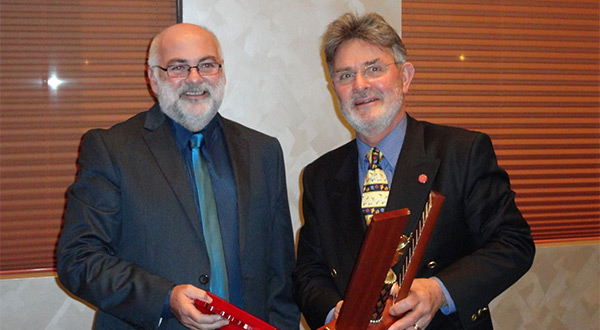
Brian O'Neill presents 2015 AREA Award to Jennifer McMahon Karratha Senior HIgh

Australian Rural Education Awards 2016

Call for Nominations

Since 1994, the Australian Rural Education Award (AREA) has been awarded annually to an institution, organisation or industry to recognise excellence in rural education in Australia.

Category 1
Existing projects that demonstrate a proven link between a rural, regional and/or remote school or learning context and the local community, and benefiting a defined group.

Category 2
Future projects that support new and creative thinking in professional practice aimed at improving student outcomes in a rural, regional and/or remote setting.

Category 3
Pre-service teachers or institutions recognising demonstrated excellence in professional learning practice in rural, regional and/or remote settings.

Category 4
Projects based in, or benefiting, rural, regional and/or remote international settings. Nominees may be based in Australia or overseas.

Category winners will receive a prize of AUD$500, complementary 2016 conference registration for one delegate and a trophy. Runners up will receive a citation recognising their achievement.

But hurry! Nominations Now close Friday 17th June 2016

How to Nominate

To nominate, please email admin@spera.asn.au with the subject line 2016 AREA Nomination, Category (Insert Number), and provide the following information:

  • Name of school / organisation / learning context / pre-service teacher
  • Postal address
  • Principal / Chief Administrator
  • Institution name / Details of sponsoring school
  • Name, telephone number and email address for the person who would accept the award
  • Category you are entering, ie. Category 1, 2, 3 or 4
  • 300 words describing the nature of the project / learning practice being recognised
  • Any additional materials to support your nomination, ie. graphics, photos, videos, details of previous awards, etc.

AREA-AWARDS-2016 (497 KB)

Australian Rural Education Award (AREA) 2015

Nominations for the 2015 Australian Rural Education Awards are now closed. Thank you to all nominees for your submissions. SPERA will be in touch in due course.

Since 1994, the Australian Rural Education Award has been awarded annually to an institution, organisation or industry to recognise excellence in rural education in Australia.

Nominations are sought in three categories:

Category 1 – Existing projects that demonstrate a proven link between a school or learning context and the rural community, and that benefit a defined group.

Category 2 – Future projects that support new and creative thinking in professional practice, aimed at improving student outcomes in rural and remote settings.

Category 3 – Five pre-service citations will be awarded to pre-service teachers or institutions, recognising demonstrated excellence in professional learning practice in rural and remote settings.

Category 1 and 2 winners will be sponsored to attend the 31st National SPERA Conference, 4-6 November 2015, at Deakin University’s Waterfront campus in Geelong, Victoria where they can showcase their successful projects. Winners also receive a further prize of $2,000 each.

Nominations are open to community groups, schools or other institutions that can demonstrate a commitment towards the positive aspects of rural education in Australia.

To be successful, nominations must clearly demonstrate an initiative that expands education opportunities for rural Australian communities.

How to Nominate

Category 1

The AREA will be awarded at the 31st National SPERA Conference dinner to an existing project that has a proven link between a school or learning context and its community in a rural and remote setting that works and improves outcomes for a defined group of students.

To nominate, please email admin@spera.asn.au with the subject line 2015 AREA Nomination, and provide the following information:

  • Name of school / organisation / learning context
  • Postal address
  • Principal / Chief Administrator
  • Name, telephone number and email address for the person who would accept the award
  • Category you are entering, ie. Category 1, 2 or 3
  • 300 words describing the nature of the project
  • Any additional materials to support your nomination, ie. graphics, photos, videos, details of previous awards, etc.

Category 2

The AREA will be awarded at the 31st National SPERA Conference dinner to a future project that supports new and creative thinking in professional practice, aimed at improving student outcomes in a rural and remote setting. This award seeks to encourage innovation and provide seeding resources to support the ongoing development of the project. The winner is required to provide SPERA with an update on their project ahead of the 2016 National SPERA Conference.

To nominate, please email admin@spera.asn.au with the subject line 2015 AREA Nomination, and provide the following information:

  • Name of school / organisation / learning context
  • Postal address
  • Principal / Chief Administrator
  • Name, telephone number and email address for the person who would accept the award
  • Category you are entering, ie. Category 1, 2 or 3
  • 300 words describing the nature of the project
  • Any additional materials to support your nomination, ie. graphics, photos, videos, details of previous awards, etc.

Category 3

In this category, five pre-service citations will be awarded to pre-service students or institutions, recognising demonstrated excellence in professional learning practice in rural and remote settings.

To nominate, please email admin@spera.asn.au with the subject line 2015 AREA Nomination, and provide the following information:

  • Name of pre-service teacher
  • Institution name / Details of sponsoring school
  • Postal address
  • Name, telephone number and email address for the person who would accept the award
  • Category you are entering, ie. Category 1, 2 or 3
  • 300 words describing the nature of the learning practice being recognised
  • Any additional materials to support your nomination, ie. graphics, photos, videos, details of previous awards, etc.

But hurry! Nominations close Friday 4th September 2015.

Australian Rural Education Award (AREA) 2014

Applications are called for in the three divisions for the 2014 AREA Awards.

  •  Division One – (existing projects)
  •  Division Two – (new projects)
  •  Division Three – (pre-service citations)

The initial application involves a brief on-line process. The selection panel will shortlist the applications. Shortlisted applicants will then be involved in a more detailed selection process.  The format for this process will be negotiable i.e. more detailed written and/or video information and Skype and/or teleconference conversations.

Applications close Friday 27 June 2014.

Download the AREA 2014 Overview and Application.

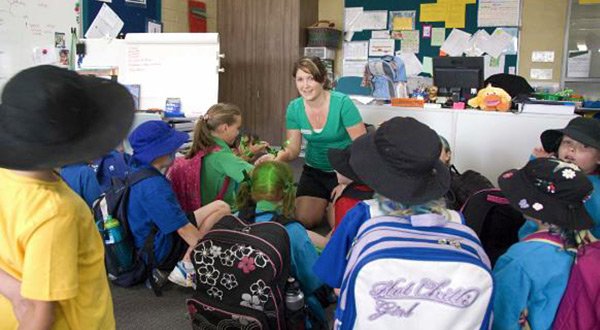
AREA 2012 Kingston Primary School

Australian Rural Education Award (AREA) 2012 Winner

Congratulations to 2012 Australian Rural Education Award winner, Kingston Primary School.

Kingston Primary School is based in Western Australia. It won the 2012 AREA for the Kingston Internship Model.

In second semester 2012, Kingston Primary School had 12 additional qualified teachers whose prime focus was to improve the literacy and numeracy outcomes of Kingston Primary School students. The interns:

  • held a duty of care
  • knew all of the students in their class
  • knew all of the parents in their class
  • understood Kingston Primary School procedures
  • knew the culture of the school.

The Kingston Internship Model was based on Twomey (2007, p.63) who said, “The more effective the practicum component of the pre-service program, the greater the livelihood of retaining new graduates in the profession.”

From an intern’s perspective, the Kingston Internship Model provided:

  • a supportive environment while learning
  • the opportunity to put university education into perspective
  • increased knowledge of classroom and school routines
  • recognition by school staff
  • the opportunity to know children for a full year
  • a positive support network
  • behaviour management knowledge
  • opportunities for further professional development
  • the experience of a full year of teaching
  • increased knowledge of the curriculum and how to teach it.

We invite you to review the Kingston Primary School’s Internship Model presentation in SlideShare.

Brian ONeill John Halsey AREA 2011

Australian Rural Education Award (AREA) 2011Winner

Principal Brian O’Neill with Prof John Halsey (Sidney Myer Chair, Rural Education and Communities)

Calen District State College, Queensland

Calen is a small rural community about fifty-seven kilometres north of Mackay. The major industry is sugar cane growing along with some small crops and fruit such as bananas and strawberries. The total population of the township is 316. The P-12 school however, has a broader catchment area and an enrolment of 230 students. With no public transport system to mackay and limited access to external training providers, students were disadvantages in terms of seeking employment and apprenticeships. The school has been proactive in providing VET opportunities for students. The Different Strokes, Different Spokes, Different Folk project is one example of these innovative measures.

The Different Strokes, Different Spokes, Different Folk project is in partnership with industry representatives and provides students from years 6-12 with the opportunity to work in a real life environment, obtain recognised vocational training and a nationally recognised credential. To date the project includes two “spokes” or components: Mechanics Matter which introduces students to the mechanical world and diesel fitting; and Radio Rocks which introduces students to the world of radio broadcasting through on-air presenting , station management and administration ands sales and marketing.

Download the CALEN AREA 2011 Presentation.

PTCWA Outstanding Professional Service Awards

The PTCWA Outstanding Professional Service Awards recognise an individual member’s outstanding professional contribution to education in Western Australia, made in a voluntary capacity to their professional teachers’ association. This provides the opportunity for each financial member association of PTCWA to consider the work of their members and nominate a worthy recipient.

The Professional Teaching Council of Western Australia has as its objective the promotion of professionalism in teaching through an enhancement of the work of professional education associations. It provides a wider context for the work of professional associations through facilitation of networking and communication between individual associations whilst providing a forum for the discussion of broad educational thought and current issues. PTCWA through its membership to the Australian Joint Council of Professional Teaching Associations affords Western Australian teachers a voice at the national level.

The individual being nominated for an Award should: be a current or past member of the nominating association; have made an outstanding contribution to the association’s support of teachers and education in WA over an extended period of time as, for example; contributing to the association’s publications either at a personal or professional level (eg served as journal editor, have developed teaching resources, have written articles, etc) as a committee member; professional development coordinator; award or accreditation coordinator; website/ ICT coordinator; and/ or have made an outstanding contribution to the association over an extended period of time through the management of the association and/ or association committees.

Australian Rural Education Award (AREA) 2010 Winner

Smart kids and Rural – Giving the Bush Back it’s Future

Gifted and talented programs are nothing new and in various forms they are dotted throughout the country. Whilst most states trumpet the value of their particular gifted and talented programs both at the primary and secondary level the stark reality is that the quality well funded programs are generally very “city centric” and target high school aged students. This in itself is a barrier to rural students .

Bunbury Education District like every other education district in WA does have a Primary Extension and Challenge (PEAC) Program in place and in 2008 we conducted a review of a program that we believed was achieving high outcomes. What the survey revealed was to the contrary and in fact it was evident that the program had stagnated, there was little connection back into student’s home schools, the courses on offer lacked academic rigour and that in the case of Year 7 students there were no direct linkages into high school. Armed with this information we canvassed widely to look at an alternative approach to PEAC that addressed these issues and as part of this approach we canvassed high schools to determine what their input should be into the program.

The response was both innovative and dynamic and sowed the seeds to develop a new initiative in Gifted and Talented education that not only has system wide implications but also has an inclusive approach that ideally suits regional locations.

Download the Bunbury AREA 2010 Winner.

PTCWA Outstanding Professional Service Award 2010

2010 Recipient: Rosa Napolitano-Lincoln

Rosa-Napolitano-LincolnRosa Napolitano-Lincoln SPERA Member was recognised on the Annual Teacher’s Day, by the Professional Teaching Council of WA (PTCWA) for her outstanding service to rural education in Australia. Rosa was nominated by her colleagues at SPERA for the PTCWA Outstanding Professional Service Award.

Rosa Napolitano-Lincoln is currently a Lecturer & Researcher – ECU – School of Psychology and Social Sciences.

Rosa has a long association with SPERA. She has been member of SPERA for 15 years. Over this time Rosa has been an outstanding advocate for rural and remote education and has also taken on a number of portfolios to promote rural and remote education across Australia, including: role of Convenor of two SPERA National Conferences held in the Goldfields and Perth; as a member of the SPERA Executive she and undertook the role of secretary, newsletter/magazine coordinator and Australian Rural Education Award co-ordinator and member of the editorial committee for the SPERA Journal – Education in Rural Australia for several years. Rosa also presented workshop papers at many SPERA conferences on challenging issues related to rural and remote education.

Rosa continues to advocate for equity in rural and remote education and has taken on additional roles including: Executive Officer with RREAC – Rural and Remote Education Advisory Council; Chairperson (State) Rural and Remote Women’s (RRR) Network (2004 – 2007) (Merit Select ) Co Editor of RRR Magazine – 4 times per year; Pre-service Teacher Supervisor (Curtin University of Technology); Pre-service Supervisor for Education and Child Care (Edith Cowan University); Quality Assurance and Compliance Director (Australian Technical College – Pilbara; Established a new model for the delivery of Gifted and Talented Education.(SPERA award 2010); teamed with Murdoch University in providing professional learning in Gifted and Talented Education to be delivered in rural areas (Post Graduate Certificate in Gifted and Talented Education; Created a new model for Murdoch University to deliver Post Graduate qualifications in Bunbury during school vacations; Provided, developed and implemented policy papers for the Australian Technical College – Pilbara. Curriculum Manager for Bunbury Education District and Special Projects Manager for Goldfields Education District (Department of Education).

Over a forty year period has taken on the role of District Director, Lecturer, Principal Consultant, Principal and Teacher within the public and private Education sectors in rural and remote locations (primary, secondary, and tertiary). Other interest focusing on rural and remote education and communities include Rosa’s involvement with: Women in Rural Leadership program (WiRL) trialled and delivered throughout WA; Currently in negotiation with Curtin University as to the inclusion of WiRL onto Executive Commercial programs; Provided leadership support to assist schools in their implementation of the Aboriginal Literacy Strategy; Provided strategic and pragmatic advice to Director – Kimberley and Principal as to the Oombulgurri Remote Community School; Department of Education Services – Inaugural Co ordinator of Rural Practicums for all WA & Universities; PCAP Rep.

image of AREA 2009 Emmy Terry John Taylor

Australian Rural Education Award (AREA) 2009 Winner

Professor John Taylor, Director, Rangelands Australia, University of Queensland with Emmy Terry, President SPERA

Rangelands Australia, University of Queensland

Traditionally, there has been little external engagement and consultation in the development of higher education products and services, with a strong focus on institutional efficiencies rather than market needs.RA has recognized the importance of matching product offerings to learner expectations, and aspired to develop offerings that would add value to current offerings, generate customer benefit and satisfaction, and increase participation in rangeland training and education.To those ends, a highly strategic, participatory and market or demand-driven approach, called social marketing (Andreasen 1995), was adopted to guide the overall development of the rangeland-specific curriculum and courses, and learner support.

Key steps have included:

  • Listening to stakeholders to clarify current and future knowledge and skill needs
  • Surveys to clarify knowledge and skill gaps in key market segments
  • Examining the alignment of offerings with expressed needs to clarify how RA could best ‘add value’ in the VET and higher education sectors
  • Developing a Quality Assurance scheme for course development, delivery and improvement
  • Understanding the market for learning in rural and regional Australia to identify the barriers to learning and strategies to reach, attract and support mature-aged students
  • Initiatives to support mature-aged learners and the development of learning communities (eg. ‘Getting into Further Study’ short course, Rangeland Champions network)
  • Course development processes to ensure relevance to current and emerging issues, and currency of information
  • Flexible course delivery to accommodate learners’ time commitments
  • Course improvement through responsiveness to student evaluations, employer feedback and external reviewers
  • Promotion of the benefits of further education and raising awareness of educational opportunities and pathways to entry

The effectiveness of these strategies is demonstrated in:

  • The rapidly growing demand for the RangelandManagement program/courses (up 105% over each of the past 3 years, and now totaling 97 people nationally, in contrast to significant declines in enrolments in other programs in agriculture and environmental studies over the same period)
  • The growing number of invitations to present on the pathways, courses and support at industry, community and government events (ie. 37 in 2008, up from 19 in 2007 and 8 in 2006)
  • Student evaluations which show very high ratings for the quality of the educational products, their relevance to work and business (eg. average scores of 4.9 and 4.8/5.0 respectively), and the way they are changing thinking and outlooks (see 2009 brochure, available at www.rangelands-australia.com.au )
  • Testimonials about the value of the suite of 12 rangeland-specific courses developed and the articulated coursework programs (see brochure and website).
SPERA Life Member Colin Boylan

2009 Life Membership Innovation Award

Principal Joyce Stark and Life Member, Dr Colin Boylan

St Joseph‘s School, Barmera

Context Statement

St Joseph’s School, Barmera is a developing Catholic primary school in the Riverland region. The school has an enrolment of 115 students from Reception to Year 7, spread across five classes. Over 10% of students are Indigenous. A large percentage of students are of Greek origin.

Barmera is a small town which relies on the fruit growing industry to sustain the local economy. Due to the unending drought, fruit growers across the region have borrowed twenty five million dollars to purchase water in the diminishing hope of keeping their crops viable. This means that any available monies are being poured into city banks to repay escalating debt, robbing the local community of its livelihood. The morale of the community is low due to the collapse of the family fruit blocks and the associated downturn in local business and employment opportunities. Times are challenging in the Riverland.

Project Description

Titled Riverland Flamenco Fiesta, the project aimed to create an opportunity for the community to come together and have fun, while raising the profile of the Spanish program at the school. The local Bonney Theatre was secured for the week and artist in residence Susi Masi from Adelaide’s Studio Flamenco, worked daily with students to develop skills in flamenco dancing. Teachers and parents also attended workshops with an adult class being held one evening. On Thursday night dancers and musicians from Studio Flamenco converged on Barmera for an evening performance. Student posters around the town ensured a full house. For some families this was the first time they had been able to go out together for the evening.

The culmination of the week’s activities was the Fiesta held on Friday morning. The day began with students, families and members of the broader community at the Bonney Theatre where senior students led prayer in Spanish. Languages teacher Carol Edwards had worked with all-classes who presented items of song, dance and poetry in Spanish. Artist-in-residence Susi Masi then invited each class to perform their flamenco dance, which was accompanied by internationally acclaimed Spanish guitarist Aloysius Leeson. WinTV filmed the students for regional broadcast. Their skill, gusto and attitude surprised some parents; one mum remarking, “I didn’t think he had it in him. ” The celebrations continued back at school as students and their families enjoyed Spanish foods, participated in a range of traditional Spanish children’s games and .cheered on their favourite, vertically grouped soccer team for the final of the St Joseph’s Euro-cup soccer. The pinatas provided a memorable finish to the Fiesta and announced the beginning of school holidays.

Descriptive Summary Statement

Who prompted development of the project?
At the beginning of 2008, Spanish teacher Carol Edwards and newly appointed principal Joyce Stark were successful with their submission for a grant as part of the Catholic Education SA Languages Grants Program. The aim was to involve not only the entire cohort of students and teachers but also the wider Barmera community in a celebration of Spanish culture to mark the International Year of Languages. From inception the project was not just for the students bur for the entire community to come together and have fun.

Who did you get involved in its establishment?
The Languages consultants from Catholic Education SA were involved in the project from its inception and liaised with Caty Manrique, Education Advisor to the Spanish Government, who attended the Fiesta and was supportive of the community. Local involvement occurred in ripples, radiating out from the school, and gathering strength from the Parents and Friends Association, School Board, local Parish, BerrilBarmera Council, Barmera Library, Studio Flamenco and friends and families associated with all of the above.

What are the long term goals?
The long term goals are to ensure that the Barmera community remains strong and vibrant: high levels of engagement in learning, standards of excellence, community involvement, hope for the future. The profile of Spanish has been raised and it is envisaged that languages learning will continue to be integral to the culture of the school. a commitment to a languages program resonates with the school’s culture of inclusion.

As the youth of the Parish prepare to go to Madrid for the 2011 World Youth Day celebrations, there are plans for the senior students from St Joseph’s School, Barmera, to also join in the pilgrimage. This has provided a focus for the teaching and learning of Spanish at the school and in the broader community. The real life context that the visit to Spain provides, drives student motivation to improve language skills and understand more about Spanish life and culture.

Who will benefit from your project?
The school has benefited from the project with community confidence in the school high. The families have benefited from the project as through involvement in the project they have built relationships with each other, and share a common focus of creating a positive future for their children.

The staff have benefited from the project as it was a catalyst for the school to identify as an inclusive environment. Spanish was experienced across the curriculum reflecting inclusive curriculum. All students were involved and were given opportunities to demonstrate their learning in different ways reflecting an inclusive pedagogy. The students have benefited from the project because they had fun learning with their peers and families as imaginations were sparked and whole beings engaged.

What effect has your project had in your area?
The Fiesta has directly led to an increased interest in the teaching and learning of Spanish. There is an increased community confidence in the school as a centre of educational excellence with a focus on positive futures in a global community. The links between the school and community were enhanced by the Fiesta with the school seen as a hub of life long, life wide learning.

The Spanish Fiesta project provided a media and social event that raised the profile of the Spanish and Arts program within the school and broader community, and for a full week, it was flamenco dancing not water allocations that dominated kitchen table conversations.

What are the distinctive rural features of the project?
Being a small country town made it possible to readily involve the local community in the project. Because times are tough, people welcomed the opportunity to join in with the celebrations, have fun with their children, engage in new learning and immerse themselves in the sense of hope that these students represent; a cohort of young learners embracing global difference in an inclusive learning environment. Low cost access to the historic Bonney Theatre, just a short walk from the school, was a distinctive rural feature of the project.

The willingness of families to participate in all aspects of the Fiesta from flamenco lessons, preparing Spanish foods, coaching and cheering on the soccer stars, decorating the school and watching themselves in the local media reflects the strong sense of belonging that families have with the school and their understanding that the someone out there who will make things happen is actually them. The Fiesta was an empowering experience for the community. It was a privilege to be part of the celebrations, as the community came together and immersed in Spanish culture, had fun.

Image of Don Boyd with his PTCWA Award

PTCWA Outstanding Professional Service Award 2009

2009 Recipient: Don Boyd

Don Boyd commenced his career as a secondary History and Economics teacher and has had 38 years of education experience which incorporates 28 years of rural education. His senior leadership roles include Head of Department; Principal District High School; Principal Senior High School; District Superintendent; Director Isolated and Distance Education; Area Director and Director Rural and Remote Education.

Don has been a long standing active member of the Society for the Provision of Education in Rural Australia (SPERA) and continues to contribute valuable service to the association and its members. His current contribution encompasses the roles of Executive Treasurer, National Conference Coordinator. representative on the Western Australian Rural Network Group, Executive Member of the Rural Education Forum of Australia, and Coordinator for the Senate Inquiry on the Federal Youth Allowance policy.

Don gives unstintingly of his time, his advice is always wise and timely and can be relied upon to volunteer for mundane tasks and at the same time be involved in vigorous policy debate. His knowledge and understanding of matters concerning rural learning communities is outstanding.

Don incorporates extensive, meaningful research as a foundation to determine evidence based and solutions focused approaches to improve education and training that has had significant recognition at local. state and national levels.

Don continues to make an outstanding contribution to the recognition and promotion of SPERA and has provided significant ongoing support to pre-service and graduate teachers across Western Australia and Australia.

In addition to his passion in improving education and training outcomes across regional. rural and remote Western Australia and Australia, Don has demonstrated his commitment to education as a whole through his previous executive roles on WATSA and HTAWA and through being a member of WADHSAA, ETAWA, ACE and ACEL. SPERA believes Don to be an excellent nominee for a PTCWA Annual Outstanding Professional Service Award.

Talbingo Clean Green Energy Park 2008

Australian Rural Education Award (AREA) 2008

The Australian Rural Education Award (AREA) is awarded to an individual, institution, organisation or industry for a practical project or achievement which opens up education opportunities for rural people and demonstrates a commitment towards advancing the positive aspects of rural education.

The Australian Rural Education Award:

  • Acknowledges excellence in rural education
  • Recognises the achievements of an individual or group in a rural community
  • Endorses a positive image of rural education
  • Demonstrates a creative approach to meeting the educational needs of rural people

The 2008 AREA winner was Talbingo Public School, with their Clean Green Energy Park project.

Download the AREA Winner 2008 Clean Green Energy Park overview.