Archive for year: 2016

Talbingo Clean Green Energy Park 2008

Country school principals take leadership challenge

An Article in Adelaide’s Independent News

Country education and regional schools around Australia are benefiting from the ‘first crop’ of rural Masters graduates, with Flinders University calling for enrollments for the second program from mid-2017.

The new Master of Education (Leadership and Management) degree offers valuable career and professional advancement to current and aspiring educational leaders from country schools as far away as outback Queensland, to rural Victoria, to South Australia’s Riverland and the South-East.

Rural education is a vast undertaking, says course coordinator Professor John Halsey.

More than 4,000 Australian schools are located in rural, regional and remote locations, and educate almost 30% of all students.

Continue reading …

Congratulations! 2016 Australian Rural Education Awards (AREA) & ISFIRE Award Recipients

Since 1994 SPERA has awarded, the Australian Rural Education Awards to an institution, organisation or industry, in recognition of excellence to Australia’s Rural Education sector . It was the first national award recognising both excellence in rural education and promoting creative ways of meeting the educational needs of rural families and their communities.
At the recent 32nd Annual SPERA Conference, held in MacKay, five awards were presented to projects which clearly demonstrated an initiative that expands education opportunities for rural Australian communities.

It is with great pleasure that SPERA awarded these projects in the following categories:

Category 1 Existing projects that demonstrate a proven link between a rural, regional and/or remote school or learning context and the local community, and benefiting a defined group.

Winner: Whole of Community Engagement Initiative, Charles Darwin University in partnership with the North Australian Indigenous Land and Sea Management Alliance, Batchelor Institute of Indigenous Tertiary Education and the Northern Territory Department of Education. It has involved building the aspiration, expectation and capacity of six very remote Indigenous communities in the Northern Territory to participate in further education. A place-based approach adopted through the WCE initiative has emerged as an innovative model to guide the ways in which Australian universities can engage with remote Indigenous communities about further education pathways.

Category 2 Future projects that support new and creative thinking in professional practice aimed at improving student outcomes in a rural, regional and/or remote setting.

Winner: ASPIRE, University of New South Wales. ASPIRE’s regional program currently targets 30 primary, central and secondary schools in areas of significant disadvantage in NSW. It’s aim is to bring a university education within the reach of students in remote and regional NSW through a variety of experiences and academic support so that students and their communities can overcome the barriers to access and succeed in a university education.

Category 3 Pre-service teachers or institutions recognising demonstrated excellence in professional learning practice in rural, regional and/or remote settings.

Winner: Rural Clinic Placement, a joint project between CQUniversity and Rockhampton Catholic Education. Over the past two years this program has enabled third year Bachelor of Oral Health students from CQUniversity to complete a voluntary rural placement in their mid‐term break. The students educate school children about oral health and treat patients in Central Queensland. The placement co‐ordinator, Associate Professor Leonie Short, has worked with Ross Jones, Assistant Director Schools: Western Region from the Catholic Education Office Diocese of Rockhampton, to organise the placement of students. The CQUniversity students plan and deliver oral health education classes in the Catholic primary schools, located in Emerald, Springsure and Clermont.  In addition the Oral Health students visit and work in the dental clinics at Springsure and Emerald hospitals. The students examine teeth and perform restorations (fillings) for the child patients. They also visit a number of dental practices in Emerald and work with the staff in those centres.

Category 4 Projects based in, or benefiting, rural, regional and/or remote international settings.

Winner: German LOTE program – Calen District State College. The Calen District State College is a small rural P-12 school with a total enrolment of 230 students. German is the LOTE taught at the school to students from years 5 to 12. One of the problems facing students of languages other than English (LOTE) in rural communities is often the lack of the opportunity to engage in conversations with native born speakers of that language.  Another problem is that rural students often have limited experience of the world beyond their communities. This project aims to overcome these problems establishing relationships with schools in Germany. Establishing email pen-pal relationship wiht students in Germany and offering Calen students the opportunity to visit Germany, experience another culture, visit larger communities and speak with native born speakers in their native tongue. The students from urban communities in Germany get to experience life in a rural community in Australia and to attend a small rural school.

An AREA Commendation was also given to the KITES (Kids in Town Engaged in School) School, Alice Springs for their project ‘Re-Engaging Kids with School’ – KITES. A whole-school program developed and driven by educator Jenny Buckley to provide a space for accessible, safe and consistent provision of learning & teaching. KITES addresses social and educational needs of children from remote areas of the Northern Territory and other states, who are ‘visiting’ Alice Springs. 

ISFIRE Award

SPERA in conjunction with SiMERR National Research Centre at the University of New England this year also presented the International Symposium for Innovation in Rural Education (ISFIRE) Award. This award was awarded in recognition of ‘Innovative strategies for improving equity in rural education in international settings’. This was awarded to the Pacific Education and Development Team, University of New England for the Nauru Teacher Education Project. In 2013, the University of New England won a tender to develop an innovative program to train local teachers in Nauru in partnership with the Republic of Nauru and Department of Foreign Affairs and Trade (DFAT) Australia. The program aims to address the heavy reliance on expatriate teachers, resulting from increasing gaps in the supply of quality local teachers proficient in subject, content and pedagogy. This is achieved whilst meeting the requirements of the Nauru Education Act (2011) that requires a two‐year teaching qualification and delivers a quality higher education experience that is contextualised to the Pacific.Notable

Notable Nominations for the 2016 Awards included:

  • Unichoice , Edith Cowan University
  • LEAP – Links (Virtual Classrooms), Macquarie University
  • The Tertiary Enabling Program, La Trobe University
  • RuralBiz Training, Kreate Pty Ltd
  • Supported Pathways to Education and Employment: Rural and Regional Program, University of Wollongong
  • LEAP – Links (Digital Literacy), Macquarie University

Winners received complimentary SPERA Conference registration, during which they had an opportunity to showcase their successful projects. Winners also received a trophy and prize of $500 each to further their endeavors.

Image of australia

THE FUTURE OF WORK: SETTING KIDS UP FOR SUCCESS

Making sense of the competing messages surrounding the future of work can be a daunting and difficult task, particularly for parents and friends wanting to ensure their children’s success.

In response, nbn and the Regional Australia Institute have partnered to build a set of practical online resources for parents and children to use today to build the skills and attributes they will need for the future.

These include a ‘Future of Work’ research report, six case studies (see below) and an online toolkit.

The Regional Australia Institute’s ‘The Future of Work – Setting Kids up for Success’ report reveals that to remain competitive in the 2030 job market, one in two Australians will need skills in programming and software development, as well as an ability to build digital technology.

Continue reading….

Hay bales in paddock

33rd National SPERA Conference, Canberra

27- 29 September 2017

Rethinking Rurality: Writing the Rural into Policy and Practice

CLICK HERE TO REGISTER

SPERA, in partnership with the Faculty of Education, Science, Technology & Mathematics at the University of Canberra, invites you to join us for the 33rd National SPERA Conference.

Hosted by University of Canberra, the 2017 conference will bring together a range of education professionals, school administrators, teacher educators, academics, pre-service teachers, community members and parents who are passionate about rural education.

Keynote Speakers include:
Professor Tom Lowrie – University of Canberra.
Professor John Fischetti – University of Newcastle.
Professor Daniela Stehlik – Griffith University.
Professor Linda Shields – Charles Sturt University.
Associate Professor Jacki Schirmer – University of Canberra.

Conference
27-29 September 2017

Where: University of Canberra, Canberra

When: 27-29 September 2017

Download the full flyer here: 2017_spera_-conference_flyer (422kb)

Call for Abstracts Submission Deadline
Friday 5 May 2017 (250 word abstracts) Email your submissions to admin@spera.asn.au

Submission of Abstracts

To submit an abstract, please download, complete and return the proposal template below.

SPERA-Abstract-Proposal-Template-2017 (59Kb)

Abstracts are to be written in plain English and include clear information about the aims, nature and content of the paper and, where applicable, a brief statement of results and implications. All abstracts should be linked to the conference theme.

Notification of Acceptance of Abstracts
Abstracts are subject to blind-review by members of the program committee. Notification of whether the abstract has been accepted for presentation will be sent to the presenter/s on or before Friday 19 May 2017.

Author Confirmation of Attendance and Registration
Successful presenters will be asked for their audio visual requirements at this time and instructed to confirm their attendance via paid registration no later than Friday 7 July 2017.

Please Note: Presenter/s must be paid registrants of the conference in order to present a paper. Registrations must be paid no later than Friday 7 July 2017. No refunds will be issued for any reason after Friday 18 August 2017.

SPERA would like to acknowledge the traditional owners of the land on which the University of Canberra is situated and pay respects to Elders past, present and emerging.

CLICK HERE TO REGISTER

Call for Editors: The Australian and International Journal of Rural Education

The Australian and International Journal of Rural Education (AIJRE) is seeking enthusiastic members of the rural education community to join its editorial board. The Australian and International Journal of Rural Education is the Journal of the Society for the Provision of Education in Rural Australia (SPERA). It serves as an international medium for educators and researchers with an interest in the provision of education in rural contexts. The Australian and International Journal of Rural Education publishes papers which may be scholarly accounts of educational research relevant to rural education, feature articles, research reports or integrative reviews.

In this instance we are seeking a number of Consulting Editors and two Chief Editors Production and Dissemination. The role descriptions for each position are below.

We invite interested parties to email journaleditor@spera.asn.au outlining their interest in joining the editorial team, their relevant experience, and an overview of their work in the field. New scholars to the field, and research students, are encouraged to apply. Please note which position you are expressing interest in.

For enquiries please contact Philip Roberts at the email address noted above.

Role descriptions:

Consulting Editors
Consulting Editors are members of the rural education research community. This may include both academics in the field, practitioners (i.e. teachers, departmental officials, research students) and other interested parties with expertise in matters pertaining to rural education. Consulting editors contribute to the overall development of the journal by reviewing publications and providing ongoing feedback about the journals direction. Consulting Editors do not need to attend editorial meetings.

Chief Editor/s Production and Dissemination
The’ Chief Editors Production and Dissemination’ are responsible for the output of the journal and the management of journal platform. Specific responsibilities include:
? (Following decision by the ‘Chief Editors Review’) Checking manuscripts for general editing, formatting and referencing.
? Ensuring the editorial is completed and included.
? Uploading final manuscripts to the journal portal.
? Publishing manuscripts on the journal portal.
? Managing necessary revisions of published articles, ensuring version control.
? Ensuring website meta-data is updated and accurate.
? Compiling each edition for lodging with INFORMIT, and lodging each edition with INFORMIT.
? Overseeing post-production dissemination, including social media dissemination.
? Attending editorial meetings.
? The Chief Editor/s Production need not be an academic in the field of rural education.

Consulting Editors
? Consulting Editors are members of the rural education research community. This may include both academics in the field, practitioners (i.e. teachers, departmental officials, research students) and other interested parties with expertise in matters pertaining to rural education. Consulting editors contribute to the overall development of the journal by reviewing publications and providing ongoing feedback about the journals direction. Consulting Editors do not need to attend editorial meetings.

Improving teaching in rural schools – we need to stop borrowing approaches from overseas

Simon White wrote in The Conversation on 6th September 2016

While statistics might show Australia has an oversupply of teachers, this masks the reality that many rural schools find it increasingly difficult to recruit and retain teachers.

This has dire consequences for the life opportunities for rural students, and contributes to the widening gap in educational results and pathways for young people born in rural communities compared to their urban counterparts.

While some policymakers might tend to look to countries such as England and the US for solutions, such models require further investigation before being adopted in to the Australian context.

Stop borrowing approaches from overseas

Australia needs a new approach to solve the rural staffing churn, and a solution might lie closer to home in investing in teacher educators’ professional learning rather than borrowing approaches from overseas.

Fast track teacher “training” programs such as Teach First in England and Teach for America seem like an appealing solution to solve the rural (and indeed remote) staffing crisis. But the logic is somewhat flawed.

The model presupposes that some people need less preparation time before being placed in the hardest to staff schools. It also only requires these people to stay for a maximum period of two years.

Continue Reading….

May 2016 Newsletter

From the President
Mr Brian O’Neill

Welcome to the first edition of our newsletter for the 2016. A great deal has been happening with SPERA and I am happy to highlight these activities in this edition.

Highlights featured in this Newsletter include the 31st National SPERA Conference which was held at Deakin University’s Waterfront Campus at Geelong in November 2015. A major highlight of SPERA’s activities for the year. Over recent months I have also represented SPERA at the Queensland ICPA Conference in Cloncurry and the Northern Territory Isolated Children’s Parents Association conference. Both organisation’s are important partners in the provision of pre-service scholarships.

This year’s National SPERA Conference will be combined with the International Symposium for Innovation in Rural Education (ISFIRE), hosted by CQUniversity Australia’s Ooralea Campus and supported by the University of Tasmania, the 2016 conference will bring together a range of national and international teachers, school administrators, teacher educators, academics, pre-service teachers, community members and parents who are passionate about rural education.

Continue reading SPERA Newsletter May 2016 (3MB)

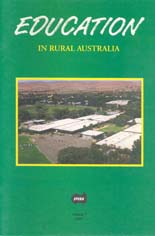
Education in Rural Australia Vol 4, No 1 (1994)

Volume 7 1997sized

Table of Contents

Brief Articles

  • The Importance of the School to Rural Community – John Nunn
  • Do Pre­-School Distance Educators Require Specialist Training? – David Kirk
  • Valuing Arts Education in Isolated Queensland – Paul Duncum, Howard Cassidy
  • The Importance of a Practical Experience in a Rural Setting for Pre­-Service Teachers – Sheila King
  • Quantitative Management, Quality Outcomes – P R d’Plesse

Brief Report

  • The Ministerial Review of Schooling in Rural Western Australia

Education in Rural Australia Vol 4, No 2 (1994)

Volume 7 1997sized

Table of Contents

Feature Articles

  • The Importance of Subject Specificity Concerns of Rural, Beginning Health and Physical Education Teachers – Doune Macdonald
  • Isolated Farmers Make Good Learners – A D Mackenzie
  • Beginner’s Tale – J M R Cameron
  • Audio-­graphic Tele-­teaching in Pre­-Service Teacher Education – Colin Boylan, Don Squires, Alan Smith
  • Staffing Issues in Remote Rural Schools – What Can New Zealand Learn from the Australian Experience? – Jan Martin
  • Isolated Schools Project – Kelly Meiklejohn, Elizabeth Barrett
  • The Australian Rural Education Award


Education in Rural Australia Vol 6, No 2 (1996)

Volume 7 1997sized

Table of Contents

Feature Articles

  • A Teaching Program in Rural Education: Learning Through Experiential Activities – Ron Oliver, Murray Lake
  • What Are We Missing? A Review of the Educational and Vocational Interests of Marginalised Rural Youth – J M Gidley, P H Wildman
  • People, Places and Learning – Helen Sheil

Brief Reports

  • Australian Rural Education Award, Recipient’s Speech – Judy Young
  • Australian Rural Education Award 1996 Disadvantage and Poverty in Rural Scotland – Dr David McSwan

Education in Rural Australia Vol 7, No 1 (1997)

Volume 7 1997sized

Table of Contents

Feature Articles

  • Educating for Cultural Understanding in Rural Communities: A Case Study – Bob Hill, Noel Thomas
  • Personal Reflections on Researching in Small Schools – Brendan Nolan

Brief Reports

  • No More SOTA for Me – Angus Seekamp
  • Home Schooling: A View of Future Education? – Sandra H Nicholls
  • Some Priorities for Planning in Your Rural School
  • Rural Parents’ Perceptions and Values and How They May Contribute to a More Contextually Based Early Childhood – Louise Hard
  • Report on the Beaver County (Oklahoma) Interactive Video Teaching Program – Kevin Farrell

Education in Rural Australia Vol 7, No 2 (1997)

Volume 7 1997sized

Table of Contents

Feature Articles

  • Towards a ‘Learning community’: The Case of Rana Primary School – Barry Cocklin
  • Consolidation of Rural Education in Hong Kong and Australia – William Hon­tong Ma, John Chi­kin Lee, Henry Chun­wai Leung
  • Rural Education in Tasmania – Graham Harrington
  • Researching in Small Schools – Results and Challenges – Brendan Nolan

Brief Reports

  • The ISP Experience – 1997 – Donna Mullins, Lana Savage
  • Australian Rural Education Research Association – Peter d’Plesse
  • Isolated Schools Project – Melinda Cranney
  • 1997 Australian Rural Education Award
  • Book Review – Reviewed by Anthony Hepworth

Education in Rural Australia Vol 8, No 1 (1998)

Volume 7 1997sized

EducTable of Contents

Feature Articles

  • Celebrating Connectedness – Robin Maslen
  • What is Ag­Ed? – Lee Mylne and Judy Linley

Brief Reports

  • Rural Students Studying in Tertiary Settings – Brian Hemmings, Russell Kay, and Doug Hill
  • Rural and Remote Professional Practice Placements for Children’s Studies Students – Stephanie Jackiewicz, Rosa Lincoln and Kristen Brockman
  • Teacher/Intern Partnerships in Isolated Areas: A Project Overview – Allan Yarrow, Roy Ballantyne, Brian Hansford, Paul Herschell and Jan Millwater
  • Australian Rural Education Award 1997

Book Review

  • Schools and Litigation: Developing Legal Policies  B.C. Nolan & J.D. Spencer – Reviewed by Ray King

Grants and Opportunities – 2017 Science and Innovation Awards


Applications for the Department of Agriculture and Water Resources 2017 Science and Innovation Awards are now open.

If you are aged 18 to 35, and focused on Agriculture, Fisheries and/or Forestry by way of research, innovation or science, you are invited to nominate for a grant of up to $22,000 to fund a project aimed at benefiting Australia’s primary industries.

There are 11 industry Science Award categories to which you can you nominate, including:

  • Cotton
  • Dairy
  • Emerging, new and established rural industries
  • Fisheries and aquaculture
  • Grains
  • Health and biosecurity
  • Meat and livestock
  • Pork
  • Red meat processing
  • Viticulture and oenology, and
  • Wool.

Winners in any category will subsequently be invited to apply for the Minister for Agriculture and Water Resources Award, which will provide additional funding for further research.

For more information, including details on how to nominate, please visit the Department of Agriculture and Water Resources website.

La Trobe Accelerator Program

On 29 August, the Victoria State Government committed $1 million through its LaunchVic initiative to fund an entrepreneur development program through La Trobe University. La Trobe, in partnership with Deakin University and Federation University Australia, will invite emerging entrepreneurs in regional Victoria to participate in what has been named the La Trobe Accelerator Program (LTAP).

LTAP will operate from each of La Trobe Uni’s campuses – in Bendigo, Shepparton and Albury-Wodonga – helping to overcome geographical barriers faced by fledgeling entrepreneurs. The program will commence in 2017, with the selection of 10 start-up companies that will be awarded funding of $20,000 in addition to mentoring and networking opportunities, industry experience and office space, to help new entrepreneurs to innovate and grow jobs in regional areas of Victoria.

Education in Rural Australia Vol 1, No 1 (1991)

Volume 7 1997sized

Table of Contents

Feature Articles

  • A Voice for Education in Rural Australia – Colin Boylan
  • What Does Social Justice Mean for Education in Rural Australia? – Ann Morrow
  • Issues in Education in Remote Rural Australia – Ted Scott
  • Catering for the Needs of Pre­-School Age Children in Rural Areas: A Case Study Margaret Clyde Parental Reasons for Sending Children to a Rural Day and Boarding School – Robert Baker, John Andrews

Brief Reports

  • A Kick Start to Rural Education – Marie Dale
  • The Rural Education Research and Development Centre – David McSwan
  • Education in Rural Australia: Farming Out City Students – Adrian Wells
  • SPERA and CEP in Rural Mitta Mitta – Carmel La Fontaine
  • SPERA Jottings – Alan Smith


Education in Rural Australia Vol 1, No 2 (1991)

Volume 7 1997sized

Table of Contents

Feature Articles

  • A Report on Satellite Education in the North­West of Victoria R. J. Cruise Rurality: “From the Inside Looking Out” – Karen Redman
  • Beginning Teachers in Small, Isolated Schools: Time to Question some Myths? – Frank Crowther, Peter Cronk, Sheila King, Ian Gibson
  • Supporting Students with Disabilities in Rural Queensland Ian Crease Curriculum and Quality in Rural Schools – Don Squires, Ron Sinclair
  • Extended School Hours at Edmund Rice College – David Lear
  • Evaluation of Remote Site Teaching: A Comparative Study – Graeme J. Byrne, Graeme Dunn, Ron Howland International News John Davis

International News – John Davis

SPERA Reports

  • The Purple People and Parents – Maggie Ramsey, Jan Temple
  • Preparation for Rural School Teaching an Living – Keith Moore
  • Management Emphasis at Burdekin Agricultural College – D. K. Beneke
  • Women into Science and Technology – A Rural Access Program – Lesley R. Warner
  • PCAP Enrichment Camp 1991 – Sheila King

Education in Rural Australia Vol 2, No 1 (1992)

Volume 7 1997sized

Table of Contents

VOLUME 2 No.1 1992

Feature Articles

  • Redefining Remoteness in the Post Industrial Society – Peter d’Plesse
  • Education and change in Rural Areas in the 1990’s – Chicken Little Was Not Wrong – Robb Mason, Shirley Randell
  • Rural Decline and community Services Education in Victoria: The Bendigo Experience – Peter Condliffe
  • Educational Extension Literature for Farmers – Just How Good Is It? – Ross Hartley
  • The Professional Standing of the Replacement Teacher in the Education Community: A Country Region’s Perspective – Barry Gill, Brian Hand
  • A Literacy Enrichment Program for Small Rural Schools – Vaughan Prain, Gaelene Rowe, Kevin Smith, Julie Walters

Brief Reports

  • The Broad Banded Equity Program of the Department of Employment, Education and Training – Colin Boylan
  • Retired City Teachers Help Isolated Children – Jennifer Sheaffe
  • The Mitta Valley Community Newspaper – Carmel LaFontaine
  • Technology and Distance Education – Robert Walker, Colin Boylan

Book Review

  • Learning on the Farm – The Educational Background and Needs of New Zealand Farmers – Ken Moore

Education in Rural Australia Vol 2, No 2 (1991)

Volume 7 1997sized

Table of Contents

Feature Articles

  • Adequacy and Equity: Prerequisites to Excellence in Rural Education – Frank Darnell
  • Perceptions of Teaching in Two Types of Isolated Australian Secondary Schools: An Analysis of Four Dimensions of Rural Education – Ken Stevens
  • Lessons for the Future: A Remote Rural Practice – Brian Hemmings, Colin Boylan
  • Remote Schooling and Information Technology: Comments on a Recent Survey – Joan Robson, Peter Routcliffe, Robert Fitzgerals

Brief Reports

  • First Year Student Essays in Humanities and Social Sciences. The Need for a New Paradigm – Howard Lukeman
  • Small Rural Primary Schools in the UK – David Keast

SPERA Responses to Recent National Enquiries

  • Consultation on the Development of a Broadbanded National Equity Program for Schools – Colin Boylan, Ron Sinclair, Don Squires
  • Response to Mayer Committee Consultation Document on Employment Related Key competencies -Sheila King
  • Report on the Rural Affairs Workshop for Key Non-­Government Organisations and Inter-Governmental Rural Affairs Offices held on 17th June 1992 in Canberra – Sheila King
  • The Australian Vocational Certificate Training System – A Rural Education and Training Perspective from SPERA – Sheila King

Education in Rural Australia Vol 3, No 2 (1993)

Volume 7 1997sized

Table of Contents

Feature Articles

  • Opening of National Distance Education Conference – Juliane Steele
  • Using Interactive Television to Deliver Professional Development Programs in Rural Victoria – Vaughan Prain, Tony Booth
  • Inclusive Education: Impact on Teachers in Small Rural Schools – Barry A Fields
  • Four Considerations Regarding the Viability of Small Rural Schools in New Zealand – Ken Stevens
  • A Regional Survey of Primary Social Education: Trialling and Results – Ray Nichol

Brief Reports

  • Isolated Schools Project – Erica Vance, Paula Sullivan
  • Higher Education Extended Campus Operations at the Sunraysia College of TAFE – Robert Cruise, R. J. Broadhead
  • A Note on Current New Zealand Research in Rural Education – Dr Ken Stevens

Book Review

  • Parker E. B., Hudson H. E., Dillman D.A. and Roscoe A. D. (1989) Rural America in The Information Age: Telecommunications Policy for Rural Development Lantham, MD, The Aspen Institute and University Press of America, pp xvi­170 – Reviewer: Ken Stevens


Education in Rural Australia Vol 3, No 1 (1993)

Volume 7 1997sized

Table of Contents

Feature Articles

  • Post Grade 10 Retention – The Human Angle – Peter d’Plesse
  • The Travelling Schools of New South Wales 1908­1949 – Ashley Freeman
  • Success Factors Relating to Alternative Delivery of Education and Training Programs – R. J. Cruise
  • Four Influences on Year Ten Career Planning in Rural Western Australia – Dr. G. A. Mason, Dr. Kenneth J. Stevens

News from the Northern Hemisphere

  • A Glimpse at Some Isolated Schools in Northern Scotland – Sheila King
  • National Conference – Schooling Through Distance Education Towards 2000 – Karen Redman
  • Bottling Their Success – Marie Dale
  • The Cairns School of Distance Education – Ian McKay

Education in Rural Australia Vol 5, No 1 (1995)

Volume 7 1997sized

Table of Contents

Feature Articles

  • Semantic Complexities in Defining Rurality: Towards a Definition Based on Human Considerations – Frances B Cameron­-Jackson
  • Instructional Flexibility in Rural and Suburban Secondary Schools in North and North West Queensland: A Comparative Analysis – Mike Staunton
  • Workplace Learning and the Use of Curriculum Statements and Profiles by Teachers of Educational Disadvantaged Students – John Retallick, Doug Hill, Colin Boylan
  • Glenora District High School – James Hill
  • President’s Annual Report – Sheila King
  • International Conference Report – David McSwan
  • Post Secondary School of Educational and Vocational Issues Facing Families in Rural North Queensland – David McSwan, Ken Stevens

Education in Rural Australia Vol 5, No 2 (1995)

Volume 7 1997sized

Table of Contents

Feature Articles

  • Addressing the Needs of the Gifted in Rural Areas. The Armidale Catholic Schools Office Project – Stan Bailey, Bruce Allen Knight, Dan Riley
  • Adult Education an Local Economic Development in Australia – Robb Mason, Shirley Randell
  • Corporate Managerialism, Itensification and the Rural Primary Principal – Elisabeth Hatton
  • Small Rural Schools and their Communities and the Impact of Rapid Change – Bernadette Bowie
  • Teaching in a Small Rural School During the 1930’s: An Oral History – Brian Hemmings
  • Interactive Television and Problem Based Learning: Viable Delivery ‘technologies’ for Rural Teacher Education – Ian W Gibson, Kay L Gibson
  • Australian Rural Education Research Association

Book Review

  • New South Wales Education Week Address – Noel Hicks, MP, Member for Riverina

Education in Rural Australia Vol 6, No 1 (1996)

Volume 7 1997sized

Table of Contents

Feature Articles

  • Expanding the Universe of Education – Elizabeth Parsons
  • Increasing Interactive Activity – Using Technology to Enhance Interaction Between Teachers, Students and Learning Material – Ruary Bucknall
  • Renewing The Rural Environment: A Real Life Story of Rural Change – Merri Gill
  • Australian Rural Education Award 1995 – A Challenge for the Future – Julie Ewers

Brief Reports

  • Opening the Door on Best Practice: Contrasting Teaching Styles in the Multigrade Classroom – S King, P Young
  • Practice Teaching in a Distance Education Centre: Expanding Opportunities for Teacher Education Students – Colin Boylan
  • The Role of the Principal in Fostering Parental Involvement in Elementary School – Wyanne Downer
  • Effects of School Size – Dr David McSwan
  • 1995 Nominations for Australian Rural Education Awards

Education in Rural Australia Vol 8, No 2 (1998)

Volume 7 1997sized

Table of Contents

Feature Articles

  • What Rural Schools Can Teach Urban Systems – Kathleen Cushman
  • Building Bridges Between Aboriginal and Western Mathematics: Creating an Effective Mathematics Learning Environment – J.A. Robinson & R.M. Nichol
  • Brightening the Lives of Shy Bush Children: The Vision of Ballarat Teachers’ College Principal William Henry Ellwood 1926 ­ 1931 – Keith Moore

Brief Reports

  • The Postal Sunday School Movement Inc Robert Price Teaching Experience in a School of the Air Heath Anderson Isolated Schools’ Project – Sheila King
  • Australian Rural Education Award 1998

Book Review

  • Sustainable Small Schools ­ A Handbook for rural Communities Craig B Howley and John M Eckman – Reviewed by Ken Stevens

Education in Rural Australia Vol 9, No 1 (1999)

Volume 7 1997sized

Table of Contents

Feature Articles

  • Educating Australian Circus Children: Strategies to Reinvigorate Rural Education – P. A. Danaher, P. M. Hallinan and B. J. Moriarty
  • Distance Teaching via Video­-conferencing in New South Wales Schools: Students’ and Teachers’ Perceptions – Colin Boylan and Rodney Francis
  • There’s Vegemite on my Assignment: An Impact Assessment of Wimmera Adult Literacy and Basic Education Group Neville Strachan Change is a Journey Taken One Step at a Time – Deidra J Young
  • A Rural Community and Its School: Contemporary Insights Through Historical Analysis – Dr Keith Moore

Brief Reports

  • Yuwaalaraay/Gamilaraay Language Revival in Walgett – Br John Giacon

Education in Rural Australia Vol 9, No 2 (1999)

Volume 7 1997sized

Table of Contents

Feature Articles

  • Listening to Country voices: Preparing, Attracting and Retaining Teachers for Rural and Remote Areas – Allan Yarrow, Paul Herschell and Jan Millwater
  • The Functions of school Councils in Canada and Australia – Colin Boylan and John Davis
  • Self-­Efficacy: A Mediating Role in Agricultural Study – Petrina Quinn
  • School and Community Partnerships: Collaborating Through the Development of Interactive, Multimedia Learning Resources – Tammy Dunn, Ian Gibson, Heather Bohaty, Gary Merritt and Erick Witherspoon
  • Developing Potential in Aboriginal Children – Graham Chaffey and Di Brown

Brief Reports

  • Reflections on Teaching Remote and Isolated Children – Geoff Rogers Birdsville Shelley Dwyer
  • Teaching in Gunpowder – Elizabeth Williams
  • 1999 Australian Rural Education Award

Education in Rural Australia Vol 10, No 1 (2000)

Volume 7 1997sized

Table of Contents

Feature Articles

  • Remote Student Access to Education via Satellite Delivery – Colin Boylan, Andrew Wallace, Wayne Richmond
  • Student Perceptions of Teacher-­Student Interpersonal Behavior and classroom Learning Environment in Metropolitan and Country Schools – Bruce G Waldrip, Darrell L Fisher

Brief Reports

  • Vocational Education and Training: Its Impact on the Traditional Education Environment – Chris Bolvig
  • Flexible Delivery of Education in Kalgoorlie: Planning and Opening a Flexible Delivery Centre of Education at Curtin University, Kalgoorlie Campus – Leslie Smith
  • Learning Technologies in the Classroom – Denise Sweetman, Lorellyn Tomlinson
  • School’s In or ‘Gathering Our Treasures’ – Michael Whiting, Julie Boyd
  • 2000 Australian Rural Education Award

Education in Rural Australia Vol 10, No 2 (2000)

Volume 7 1997sized

Table of Contents

Feature Articles

  • Isolated Parents’ Perceptions of the Education of their Children with Disabilities – Diana du Plessis and Jeff Bailey

Short Articles

  • A Composer ­in­ Residence Project at Meekatharra School of the Air, Western Australia – Belinda Yourn,
  • Providing Vocational Education and Training (VET) in NSW Rural Schools and Students: The ‘state of play’ – Don Squires
  • Student Teacher Reports Isolated Schools Project – Sherrin Bell
  • Teaching in a Small Rural Community – Michelle MacCartie,
  • Internship in a Small Rural School – what an experience! – Bonnie Hieatt
  • Anyway, What is a Children’s Services Advisor? – Kylie Duffy
  • What’s So Good About a Small Rural School? …. EVERYTHING! – Michelle Cook
  • Rural Kid, Rural Adult, Rural Teacher: Diary of an intern – Jodi Penfold

Notices

  • 2000 Australian Rural Education Award
  • 2001 Australian Rural Education Award
  • Call for Visual Material Call for Manuscripts
  • Guide to Contributors
  • 2001 Journal Renewal

Education in Rural Australia Vol 11, No 1 (2001)

Volume 7 1997sized

Table of Contents

Feature Articles

  • ‘Now, Year Ones, this is your life!’ Preparing the present generation of students for a world of – Hedley Beare

Short Articles

  • Parents’ perceptions of planning for and provision of early childhood services in rural and regional NSW – Tracey Simpson, Charles Sturt University, Bathurst
  • Review of contemporary issues for rural schools – Peter Arnold, Principal, Thurgoona Public School, NSW
  • Designing a flexible model of learning for a rural health organisation: a case study – Melissa Mills, Rural Health Education and Research Centre, Tamworth
  • Rural students and graphics calculators in examinations – David Haimes and Beverley Webster, Curtin University of Technology
  • Lessons from the past: education and racism in Australia – Myra Dunn, Charles Sturt University

Education in Rural Australia Vol 11, No 2 (2001)

Volume 7 1997sized

Table of Contents

Feature Articles

  • Cultural Practices of Pedagogy: Literacy Contexts for Young Aboriginal Students in Inner & Outer Regional Australia – Susan Clancy and Lee Simpson, Charles Sturt University
  • Empowering an Indigenous Rural Community: Local Teachers for Local Schools – John Delany and Derek Wenmouth, Distance Education Coordinators, Christchurch College of Education
  • Sport, Physical Education and Country Towns: Diverse Enough? – Michael Gard, Human Movement Studies Unit, Charles Sturt University
  • Otitis Media, Learning and Community – David McSwan, Emma Clinch and Ron Store, Rural Education Research and Development Centre, James Cook University
  • “Good Morning, I’m a Heterosexual”: A case in the closet in rural Australia – Belinda Downey, Charles Sturt University

From the Field

  • A Rural Bridging course for women and problem based learning – Judith Wooller and Lesley Warner, Central Queensland University
  • Building A Sustainable Approach to Working In A Diverse Community: A Country Areas Program (CAP) District Initiative, including Walgett Public School, St Joseph’s Primary School Walgett, personnel from the Walgett Community of Schools and members of the Walgett community – Workshop presenters: Dr R V (Bob) Morgan – Director, Murri Consultants & Associates Ms Liz Sweaney – CAP Consultant, Batemans Bay CAP District Mrs Shirley Fuller – CAP Consultant, Moree CAP District